

By Robert S. Miller
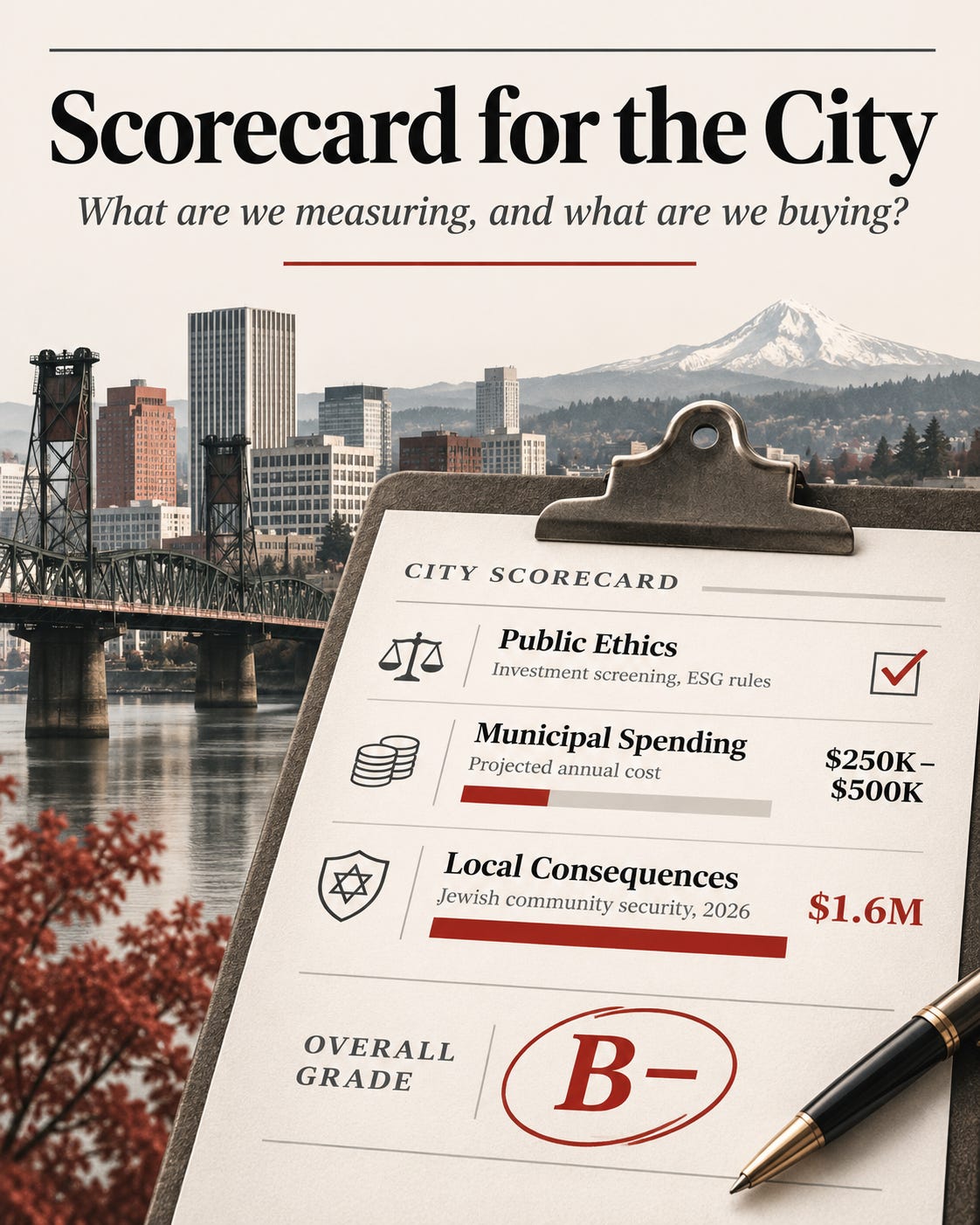
I owe six members of the Portland City Council an apology. When Candace Avalos, Jamie Dunphy, Mitch Green, Sameer Kanal, Tiffany Koyama Lane and Angelita Morillo signed their pledge last October to investigate Portland’s alleged complicity in Israeli genocide and apartheid, I assumed they had undertaken one of those grand international missions for which municipal governments are so admirably equipped. I expected an impassioned resolution, several speeches and perhaps a strongly worded letter to somebody in Jerusalem who has never heard of Portland.
I underestimated them. On Nov. 5, the Finance and Governance Committee of the Whole voted 11-0 to send the 2027 Investment Policy, Resolution 2026-396, to the full council with a recommendation to pass.
Councilor Olivia Clark was absent. Councilor Eric Zimmerman, the lone no when the council ordered the screen studied last December, voted aye. The policy carries a new Section XVI: a human-rights screen on the city’s corporate bond holdings, run through a third-party provider at a cost of $250,000 to $500,000 a year, according to the resolution’s own impact statement. It would be paid from the portfolio’s interest earnings.
Having spent much of my professional life evaluating investments and operating businesses, I have the unfortunate habit of asking what we’re buying.
What the Treasurer said
Councilor Zimmerman asked a version of that question, and city Treasurer Brigid O’Callaghan’s answer was illuminating. The original staff proposal, she said, anticipated very minor changes to the firms available for investment. Asked whether the city held anything the screen would remove, she answered: “No, we are not investing in any known human rights violators that would be removed from the list.”
The numbers behind that answer are the city’s own. The cash portfolio stood at $2.825 billion at book value on June 30, of which $851 million, about 30%, was in corporate bonds. These are not speculative stakes in obscure foreign enterprises. Portland operates under Oregon statute, credit-quality requirements, maturity limits and existing industry exclusions. Chief Financial Officer Jonas Biery told the committee that about 35 corporations pass the city’s existing credit and industry screens.
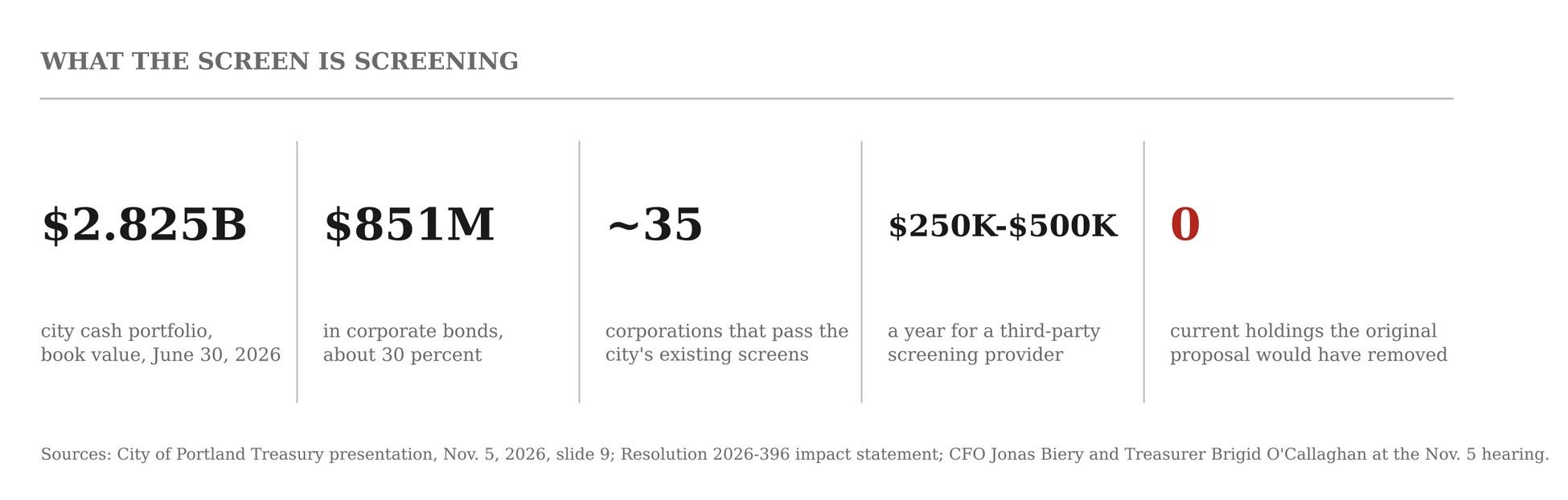
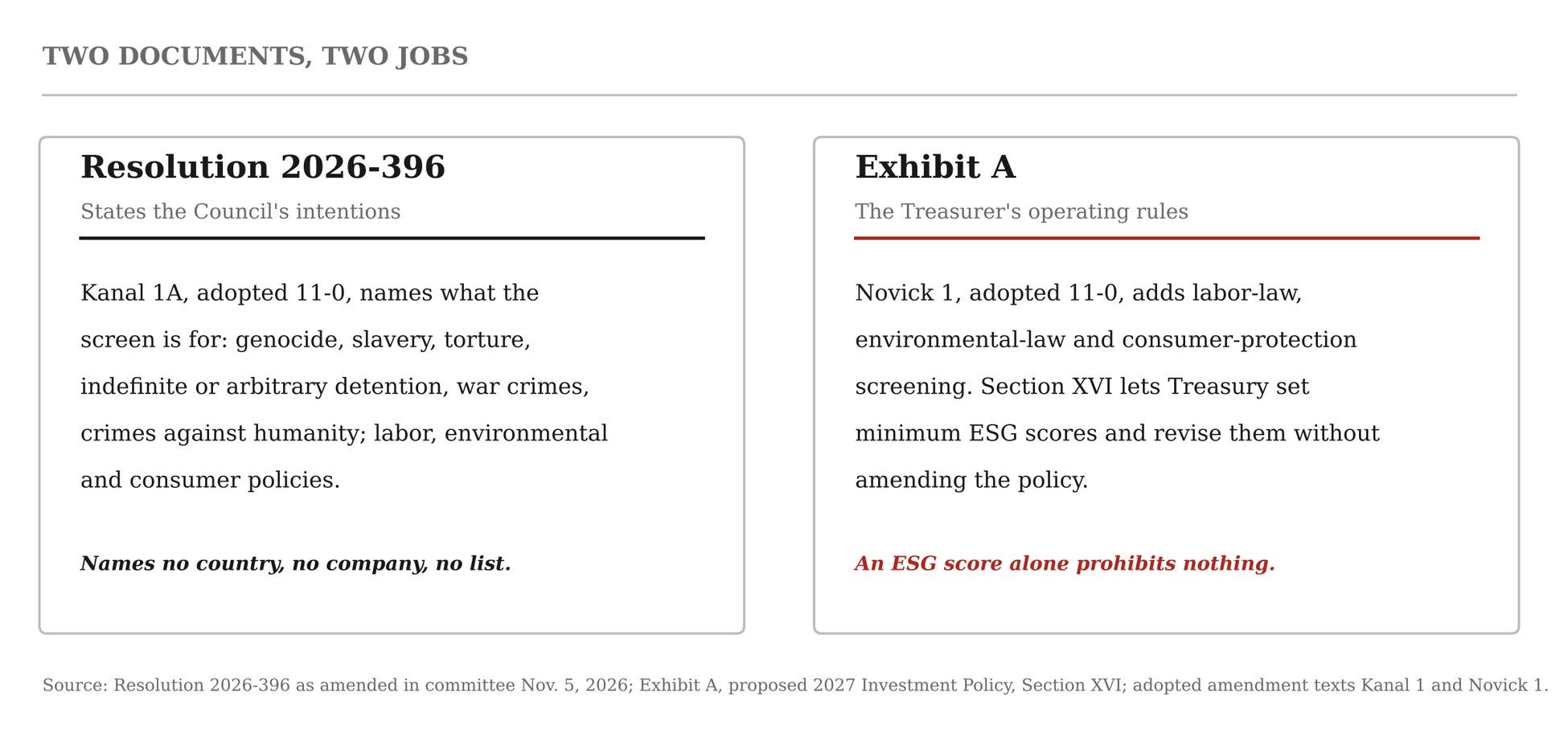
Then came the amendments. Kanal 1A, moved by Sameer Kanal and passed 11-0, reaffirms the council’s commitment to human-rights screening and says what it means: genocide, slavery, torture, indefinite or arbitrary detention, war crimes and crimes against humanity, along with labor, environmental and consumer policies. Novick 1, moved by Steve Novick and also passed 11-0, adds labor-law, environmental-law and consumer-protection screening to Exhibit A, the operating rules the treasurer actually follows.
Neither amendment names a country, a company or a list and neither names ICE, which figured in public testimony. Here is the detail worth holding onto. The strong language, the genocide and the war crimes, went into the resolution, which states the council’s intentions. It did not go into Exhibit A, which governs what the treasurer may buy. Exhibit A says in so many words that an ESG score alone does not prohibit an otherwise permitted investment.
Zimmerman kept asking what would actually change. The treasurer could not say. Her answer about known violators described the original proposal; the amendments had just been adopted, and the screening system itself has not been designed.
I found myself admiring the sequence. Eleven councilors approved the cost of a new system before the standards by which its success will be measured exist. That is not necessarily bad government, but the costs are easier to describe than the benefits.
Preventive screening can be valuable. A smoke detector is useful even when a building isn’t on fire. But when somebody offers me a smoke detector for half a million dollars a year, I would like to know whether it comes with its own fire department, whether my existing detector is defective and whether the smoke detector manufacturer has hired a lobbyist.
The supporters have a serious argument: The city should not lend public money to corporations connected to war, human-rights abuses or exploitative labor, and the rules should be universal and transparent. Those are defensible objectives.
But this journey did not begin neutrally. The six councilors began with a pledge about Israel. Eli Berne, director of government affairs at the Jewish Federation of Greater Portland, asked whether the policy would bar excluding a company solely for its nationality, where it operates or its lawful commercial relationships with a particular country. The treasurer noted that the city is already barred from investing directly in foreign governments. That answers a different question. Berne was asking about corporations and where they do business, exactly what a proper screening system ought to answer.
Human-rights cost
If the city is prepared to spend up to half a million dollars a year determining whether its bonds are associated with violations of human rights elsewhere, it might also measure how well it protects the rights of religious minorities at home.
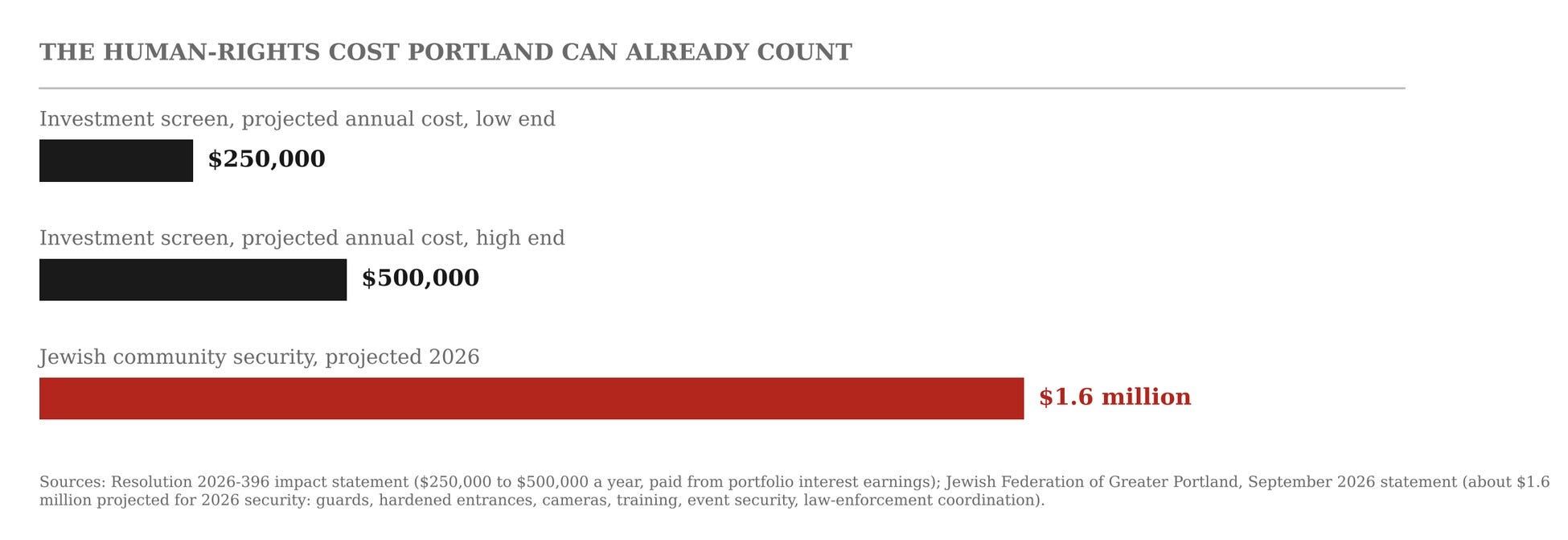
Portland’s Jewish community expected to spend about $1.6 million on security in 2026, according to the Jewish Federation of Greater Portland, for guards at synagogue entrances, hardened entrances at schools and preschools, cameras, training and security at communal events. A small community is spending substantial private money to exercise a constitutional freedom most Americans take for granted.
I have become accustomed to showing identification before entering a synagogue. I don’t resent the guard. I appreciate him. What troubles me is that his presence has become such an ordinary part of religious life.
God knows who I am, but apparently the person responsible for protecting the entrance requires documentary evidence.
I am not asking the city to pay for synagogue guards. I am asking it to measure. Imagine a municipal human-rights scorecard with one indicator: the private cost of exercising religious freedom, set beside what the city spends screening bonds for conduct elsewhere. I suspect that would be a less comfortable exercise. The threatened worshippers live here. The institutions have addresses. The costs can be counted. Everyone in Portland is free to worship. Some of us need to bring identification and contribute to the security fund.
Careful what you count
There is an old Soviet story in which a factory met its quota for the weight of nails by producing a few enormous nails nobody could use. When the quota was changed to the number of nails, it produced millions of tiny ones. The standard simply failed to measure what anyone needed.
That is the danger of confusing compliance with performance. We can count the issuers screened and the reports filed. They will not tell us whether anyone is safer. People become very good at producing whatever administrators choose to count. Portland should be careful what it counts.
So before the full council votes, five questions, for this screen and for anything else that requires public money or governmental authority.
What legal authority and genuine municipal responsibility justify the action?
Would we apply the same standard to everyone, including those with whom we disagree politically?
What measurable benefit are we purchasing or protecting?
What will it cost, including the opportunities we give up by spending the money here rather than elsewhere?
What evidence would convince us the policy had failed and ought to be changed or discontinued?
The last question matters most. In business, we occasionally have to acknowledge that a product, an investment or a strategy has failed. Municipal governments have perfected the more optimistic conclusion that success has merely been postponed.
Before the council approves another recurring expenditure, the city could publish the expected effects on the portfolio, the criteria to be used and the evidence by which the screen will be judged.
I have no objection to Portland aspiring to be a more ethical city. I would welcome it. I would simply like to know whether we are becoming one, how we would recognize success, and what we are giving up along the way.
Our six councilors began by looking toward Israel. Their most useful destination may turn out to be much closer to home.
And before we spend half a million dollars a year evaluating the ethics of the city’s bonds, I have one request. Could somebody show me the scorecard for the city itself?
Robert S. Miller is a Pearl District resident who has contributed eight prior essays on this site regarding the Portland charter and its ramificaitons.