


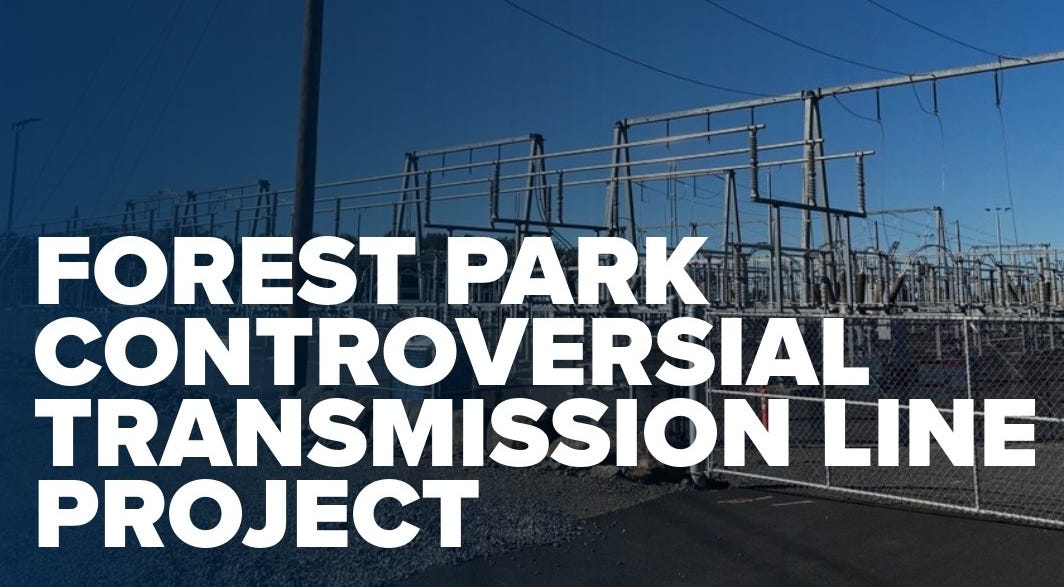
How did the city of Portland negotiate a clear victory over Portland General Electric’s proposed power line extension across sacrosanct Forest Park and turn it into a defeat?
“This is absolutely devastating and so underhanded,” said Darcie Meihoff, president of Oregon Wild and former president of Forest Park Conservancy. “How dare the city of Portland so blatantly cave to private interests over the public, our treasured Forest Park and the environment?”
Portlanders have been left to wonder because the man who signed the peace agreement, the city’s new and first city administrator, Raymond Lee, isn’t talking. Even local political veterans have no inkling as to whether Lee was acting on his own judgment or merely carrying out the will of his boss, Mayor Keith Wilson, or perhaps listening to City Council representatives.
Terms of the deal binding city staff to recommend approval is the product of a private mediation process in which participants are either legally bound to secrecy or are choosing to remain mum.
Portland City Council voted 12-0 in April 2025 to reject PGE’s application. This from a deeply divided council that rarely agrees on anything of high consequence or deep controversy. Even though PGE appealed that decision to the Oregon Land Use Board of Appeals, environmental and neighborhood groups on the other side were not that worried. LUBA does not reevaluate the general merits of cases but merely determines if policymakers followed laws and procedures, and consider evidence to back its action.
We may never know the strength of its case for appeal because PGE sought mediation, which brought the mayor, the city administrator and two members of the City Council into closed-door talks. Other parties to the case—the Forest Park Conservancy, Bird Alliance of Oregon and Forest Park Neighborhood Association—participated only in earlier stages of mediation and were not in the room when Lee signed the agreement on July 2.
City of Portland Media Manager Chenoa Philabaum told the NW Examiner that Lee made the call.
“Neither members of the council nor the mayor were decision-makers or signatories to the settlement agreement,” Philabaum wrote. “That agreement was made between the city’s executive branch and PGE.”
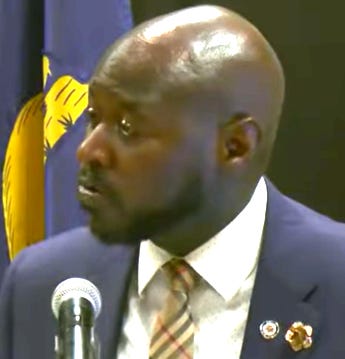
Lee has not responded to the Examiner’s request to comment. Some readers are troubled by the thought that a newcomer to the city would be allowed to make such a pivotal decision.
“He has barely lived in Portland months,” wrote Joni Johnson. “I don’t think his mandate is to overturn previous policy approved by the council. I’d like Raymond Lee to get the budget under control and demonstrate he has the fortitude to make hard choices to reduce the cost of city government. Then let him flex his muscles.”
“We have a carpet-bagging city administrator who is wasting no time in leaving his mark,” Paul Douglas wrote. “I thought the city administrator worked under the mayor under our new, so-called charter reform. Is the mayor culpable for allowing his underling to set policy like this?”
Who chose the players?
Bob Weinstein, the former mayor of Ketchikan, Alaska, and a Portland District 4 council candidate in 2024, has a lot of questions about how the agreement came to be.
“The council voted 12-0 to reject this project,” Weinstein wrote. “Twelve to zero. Neighborhood associations, the Forest Park Conservancy, Bird Alliance of Oregon—and even city staff’s own testimony—opposed it. Yet now the city administrator secretly signs an agreement committing staff to recommend approval of essentially the same project.
“The deal is bad, and the process, which involved the city and PGE cutting the environmental intervenors out of the discussion, may be worse.
“This is the culture critics have complained about for years: Unelected staff deciding they know better than the council and the public, and simply working around a decision until they get the outcome they wanted all along. If a 12-0 vote isn’t ‘policy direction,’ what is?” Weinstein asked.
As to the role of City Councilors Mitch Green and Steve Novick and how they got in the room, Philabaum wrote, “All of council, including Councilors Green and Novick, were invited to participate in any portion of the mediation.”
District 4 Councilors Eric Zimmerman and Olivia Clark told the Examiner they have no idea how the two men from their midst came to be there.
Green and Novick’s participation in the process may be the murkiest part of the whole deal.
Philabaum said the topics discussed in mediation were:
The project’s compliance with applicable approval criteria,
Ecological impacts within Forest Park and
Potential additional mitigation and restoration measures.
According to Philabaum, “Under city code, councilors are required to avoid receiving information from interested parties on a pending land-use application that could be appealed to the council and to avoid saying or doing anything that could demonstrate bias.”
If that rule were applied, Green and Novick should not have been within earshot of the mediation. But Philabaum drew a different application to the “hear no evil” proscription.
Having collected a large volume of information during hours of mediation, Green and Novick are then expected to act as if they know nothing. “As a result [of the city code stricture], the councilors aren’t able to share opinions on the matter at this time,” she wrote.
Whether Green and Novick eventually share what they learned in secret or not, the situtation creates complications, particularly for their council colleagues. The next time either speaks publicly or privately on the PGE subject, will council members detect a change in tone or thought? Will they wonder if Green and Novick now see the situation differently as a result of their immersion in PGE’s uncensored arguments?
That is the corrupting influence of ex parti contact, which eats away at the assumption of a level playing field for all. Disclosure and recusal can limit the damage of inappropriate contact with one side, but denial and silence about actions possibly crossing the lines only incubate further distrust.
Why Green and Novick?
“The biggest unanswered question is why Councilors Green and Novick were selected,” Weinstein wrote. “Was that the mayor’s decision, the council’s or the city administrator’s? The public has never been told.
“We know it was not the council’s decision as a body. It was never on an agenda, and a couple council members have reportedly said they knew nothing about it. If it were Wilson’s call, that’s a meaningful detail, especially if he’s seen as sympathetic to PGE’s position, as it would suggest the choice of participants wasn’t neutral.”
“My assumption is that the city administrator would not have signed an agreement of this magnitude if the participating councilors had strongly objected.
“They have information the other council members don’t have, so they are in a unique position to explain and perhaps advocate for the agreement when it eventually comes before the council. Also, I don’t think this agreement would have been signed without the mayor’s OK, since the city administrator reports to him.”
Out in the cold
The three nonprofits left out of the process have no confidence in the path taken.
“The city and the conservation advocates agreed to enter into mediation with PGE to attempt to agree on an alternative to PGE’s proposal,” according to a Bird Alliance of Oregon newsletter. “After four months of mediation, city leadership entered into bilateral negotiations with PGE, cutting out the conservation partners from the negotiation.”
“We are frustrated that the city has caved to PGE’s pressure campaign, and is poised to approve their destructive project in Forest Park,” wrote Micah Meskel, director of urban conservation for the Bird Alliance.
“We were asked to sign this agreement but declined,” wrote Carole Hardy, a Forest Park Conservancy officer who was participated in the mediation.
Hardy said PGE brought nothing new to the table, particularly regarding energy demand forecasts or alternative routes outside the park.
“What is odd is that staff is directed to write a favorable report” on matters they so recently rejected, she said. “How can they now write a favorable report?
“This agreement threatens to turn public review into a formality. We urge Portlanders to make their voices heard and tell City Council not to give away critical park resources, pre-determine the outcome of a future application or sideline the public input that helped protect the park in the first place.”
And future applications are likely to follow.
“This decision isn’t just about a single transmission project,” Hardy continued. “This is just one example of PGE attempting to bypass local conservation and land-use policy … PGE plans two more development projects in the same sensitive area of Forest Park over the next 10 years. Αs planned. These projects would harm more than 15 additional acres of the park. We have to consider the precedent we are setting by allowing a deal made outside of public view to stand.”
Hardy emphasizes that the agreement settled nothing. A new application will come back to the council, which is free to evaluate it on its merits.
“We need the public to know that this is there chance to speak up,” she said.
My response to this is parallel to my response to the U.S. Congress these days. If one person is able to override decisions, even unanimous decisions, then let’s send Congress home and send the Portland City commissioners home. If they have no power to represent us, we shouldn’t be paying them to do so. At least in the old days there were fewer City councillors.
Now, we’re paying 12 salaries, only to have someone else make the decision.😡
I understand why many people feel disappointed. After a unanimous 12–0 City Council vote rejecting the proposal, it was reasonable to believe the project was effectively over. When the City later entered into a mediation agreement, it understandably felt to some like the rules had changed.
At the same time, once PGE appealed to LUBA, the City had to decide whether to continue litigating or attempt to negotiate a resolution. Governments settle land-use disputes every day because litigation carries costs, risks, and uncertainty. Choosing mediation does not necessarily mean the City concluded PGE was right.
The agreement also did not approve the project. PGE must still submit a revised application that will go through public hearings, and any approval can be appealed to the City Council, then to LUBA, and potentially into the courts. Public accountability has not been eliminated—it has simply moved to the next stage of the legal process.
I’m also skeptical that the City Administrator acted alone. Given that the position serves at the pleasure of the Mayor, it would be unusual for an agreement of this magnitude to be signed without the Mayor’s knowledge and approval.
I’m looking forward to the public hearings, especially to see whether PGE provides a more detailed explanation of why it cannot rely more extensively on the existing BPA transmission corridor through Forest Park.
One final observation: Calling the City Administrator a “carpetbagger” strikes me as unnecessary. The agreement should be judged on its merits, not on how long he has lived in Portland. The term also carries historical baggage, making it a questionable choice of words.