



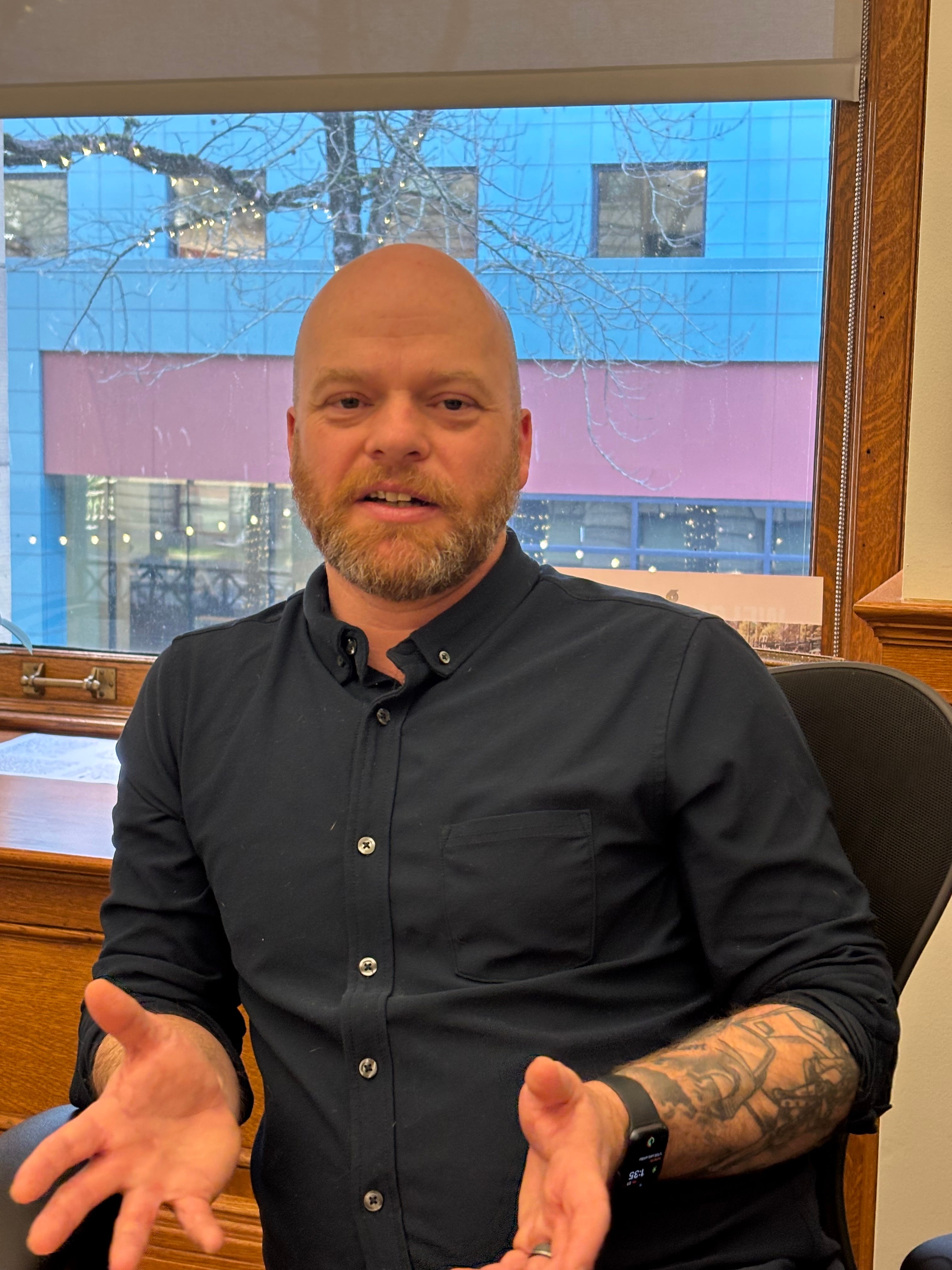
Mitch Green dresses for the situation, whether talking to Pearl neighbors (left) or about to assume office.
I first saw Mitch Green in a suit when he was assuming office as a District 4 city councilor in 2025. Before that—and in all his campaign materials—he wore working-man’s shirts or sweaters with rolled up sleeves. But a formally attired Green assured me he understood his different roles and the sartorial tone expected of each.
Of the six members who formed the council’s progressive caucus in 2025—and he says he is no longer part of Peacock—Green is the one most able to converse across the aisle. As he frequently reminds, he has a Ph.D. in economics, which he put to use as a senior risk analyst for the Bonneville Power Administration.
He gets along with his two District 4 colleagues—Olivia Clark and Eric Zimmerman—despite fervent disagreements on some issues. At a City Club forum in February, all three agreed that collegiality described their working relationships, a trait not so apparent in Portland’s three other council districts.
But his compromising ways go only so far.
“I am a socialist, and I’ve been pretty honest about who I am,” he said. “I’m not going to apologize for being a DSA (Democratic Socialists of America) member. … I’m proud to be part of that organization because they have a pretty unabashed pro-working class politics.”
He believes he has handled his two sides well.
“At the dais, I very seldom wear a firebrand [hat],” he said. “The part of me that’s like megaphone in hand, out on the picket line doing the rally—that’s always going to be a part of me, and that’s an important political function that I think I can still play, even as an elected official. But I don’t think that’s an appropriate function for my work at the dais [where] my work is to advance policy and to try to win over my colleagues.
“Sometimes I think there are folks out in chambers who would prefer that I’m a little bit more radical and have much more fight in my voice. I think there are people who prefer I attack my colleagues, and I don’t do that—especially with my colleagues.”
A delicate balance, perhaps, “but I don’t think I’ve misled anyone,” he said.
Protest and the purse
Some likened his militancy in pursuit of political goals to that of President Donald Trump.
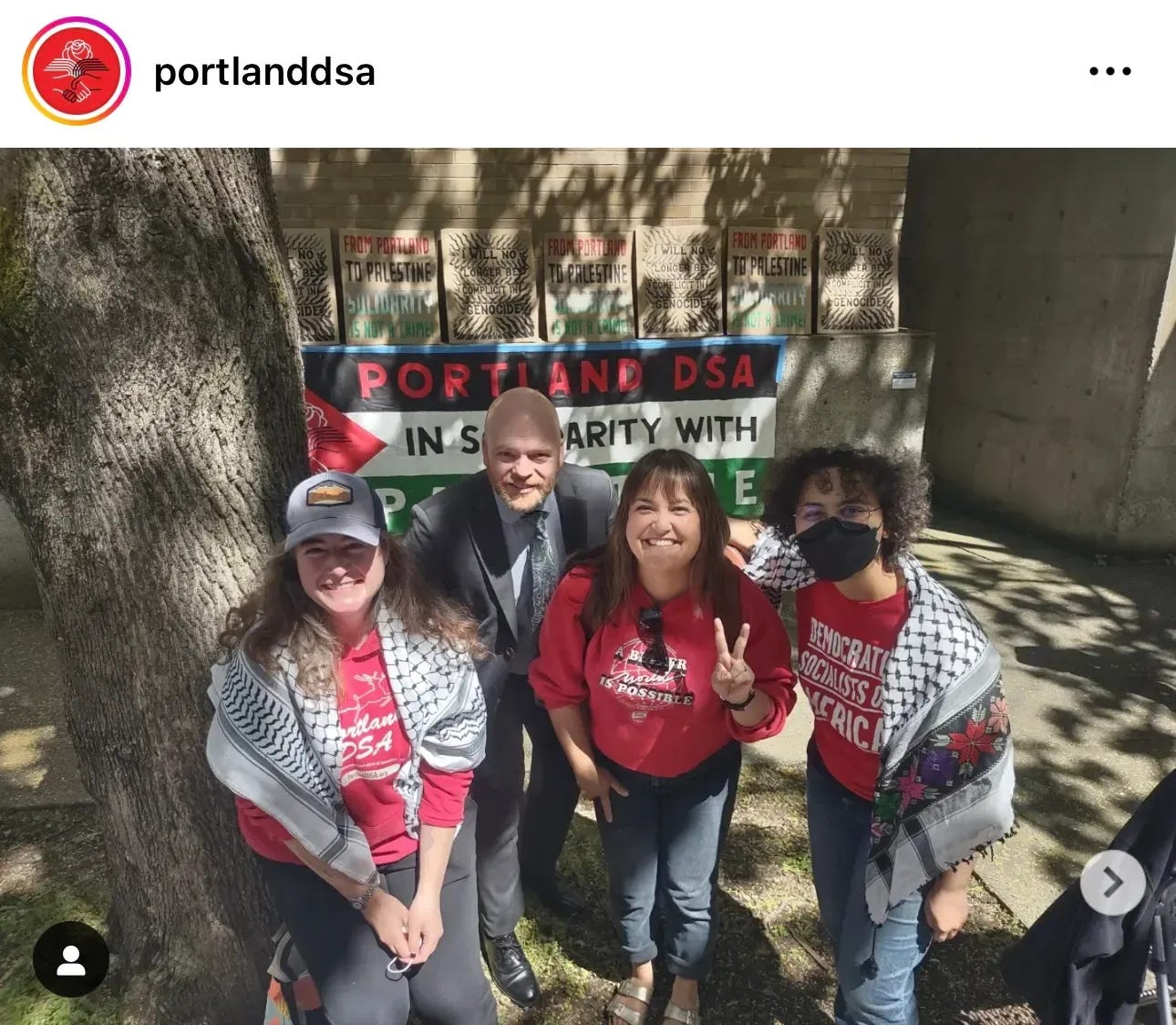
That was related to a statement he made before DSA faithful at Portland State University last spring after a library occupation turned into an extended takeover causing $1.2 million in damages and taking five months to reopen. He insisted that all charges against students be dropped, and he backed that demand with his special leverage as a legislator.
“Portland State University depends on Portland City Council for a number of things that they want to do, so if we want to show up and use our lever on City Council, it’s through the power of the purse,” Green announced to the news media.
“So on this day of action, I’m just going to say that I know that the administration is planning to build a performing arts center, and they’re going to come to City Council for money for that. And if they want my vote, they’re going to have to drop the charges on those students. And they’re going to need my vote to get that money because I am in solidarity in coalition with other leftists on City Council. We know how to stand up and fight back.”
“To me he’s using a position of power to threaten, intimidate and blackmail PSU,” said Goose Hollow resident Kara Colley. “That sounds to me like an abuse of power and analogous to what Trump is doing.”
Later, Green explained to the NW Examiner why his position was different from Trump holding up funds to get his way in Ukraine, for example.
“I think it was an unfair characterization because Donald Trump is holding up already legislated and approved funds that Congress has already decided are good things that should flow. He is saying, ‘I will stop that payment unless you get on board with my program.’
“I’m not the executive, and I don’t have any power to do that, but when I ran for this office—and I talked to students at Portland State University—I told them I would fight for them. I think it’s disingenuous to say that and then immediately not fight for them, especially where I’m in a position where the bully pulpit does matter, and I know that Portland State University is going to be sniffing around for some money for this new performing arts center.
“If I have an opportunity to influence their decision by letting them know where I stand—what my values are—I’m going to use it, and I don’t think that’s Trumpian.”
Doom loop
There was another situation in which Green shocked mainstream observers. The U.S. Bancorp Tower, better known as Big Pink, sold to Jeff Swickard last July for $45 million, 12% of its 2015 sale price of $372 million. It was among a spate of fire-sale deals involving major downtown real estate and fed into a “doom loop” narrative, in which collapsing property values lead to collapsing tax revenues, combining to thwart public and private efforts to bring about recovery.
In an exchange on Chat with Peacock members later retrieved by Willamette Week in a public records request, Green expressed no fear.
“I think the sale of Big Pink at such a discount relative to its previous valuation is a really good thing,” he wrote. “It’s good for two of the following reasons.”
He then explained that lower property values would reduce rents across the board, while providing an opportunity for the city or nonprofits to acquire buildings more cheaply for residential use.
Asked later by the Examiner to explain his position, he offered a more anodyne version.
“[Some] are suggesting that my economic credentials are called into question for saying such a thing, but I’ll tell you, it is a fundamental fact of a market economy that if you’re going to have prices reflect values in a market, then you need to have the opportunity for conditions to adjust. And what happened in the last decade in this city was a run-up in valuation, and some of these buildings were acquired by hedge funds or outside investment firms with heavy loan finance.
“So Jeff Swickard saw an opportunity, and … he’s already talked about all of his plans to activate the space,” he said. “When you buy that low, you can afford to set the rents at bargain prices too so you can induce tenants to come in, and that’s going to be great for our downtown activation.”
In other words, capitalism self-corrects, and social benefits will redound to society. But that’s not his core approach to providing affordable homes for all. There he sees a need for social housing, the vision he and a delegation of city officials explored in a trip to Austria last year.
In a statement posted on the city’s website, he wrote, “Our current housing system is constrained by federal funding and policies beyond our local control. We need a model that is financed and governed right here in Portland. That model is social housing—permanently affordable, high-quality housing for all that serves the public good, not private profit.”
Tenant rights are essential.
“Imagine a system where tenant unions are not just a reaction to crisis but are built into the governance structure of the housing itself. This would create a powerful, citywide voice for renters to ensure their homes are maintained and their rights are respected,” he wrote.
Under a city charter in which council members gain election by reaching a 25% support threshold, the Examiner asked him if 25% of voters love what he’s doing while a majority hate it, would he define that as success?
“I think success would be to have most people think I’m a fair and good steward of the public trust. You’re not going to make all the people happy all the time, but I ran for this seat because I said I was fighting for very specific values. I think I’d be a failure for me to abandon those values.”
The respect of most voters would be nice, but in Portland’s unique ranked-choice voting system, it only takes 25% to win.
Green needs to be replaced. Vote him out
Mitch Green: “Our current housing system is constrained by federal funding and policies beyond our local control. We need a model that is financed and governed right here in Portland. That model is social housing—permanently affordable, high-quality housing for all that serves the public good, not private profit.”
Tenant rights are essential.
“Imagine a system where tenant unions are not just a reaction to crisis but are built into the governance structure of the housing itself. This would create a powerful, citywide voice for renters to ensure their homes are maintained and their rights are respected,” he wrote.
This is exactly why I could not vote for Mitch Green. Portland and Multnomah County are notorious for creating pie-in-the sky projects without viable, long term plans on how to fund them. Permanently affordable means somebody has to permanently subsidize this "high qualtity housing", and who is that going to be? We've recently discovered what "high quality housing" through Home Forward looks like : https://www.wweek.com/news/2026/04/01/a-2022-policy-change-eliminated-one-of-home-forwards-tools-for-controlling-bad-behavior/
and who can forget this WW expose: https://www.wweek.com/news/2023/06/07/a-28-million-low-income-apartment-complex-descends-into-chaos-in-just-two-and-a-half-years/ .
Junketeering Mitch Green is delusional if he thinks Portlandia or Multnomah County can competently fund, create and then maintain "quality" public housing cost-effectively, fairly and responsibly. But I'm sure he'll be willing to spend a whole lot of taxpayer money to try emulating what he thinks he saw in Austria.