Pearl resident Art Lewellan has spent most of his life advocating for mass transit; imagining how it could be better, especially in his hometown. His health is failing now, but his mind is focused on sharing what he has learned and written about over the years.
Be prepared for acronyms: PHEV, HFCEV and his favorite one of late: LOTi.
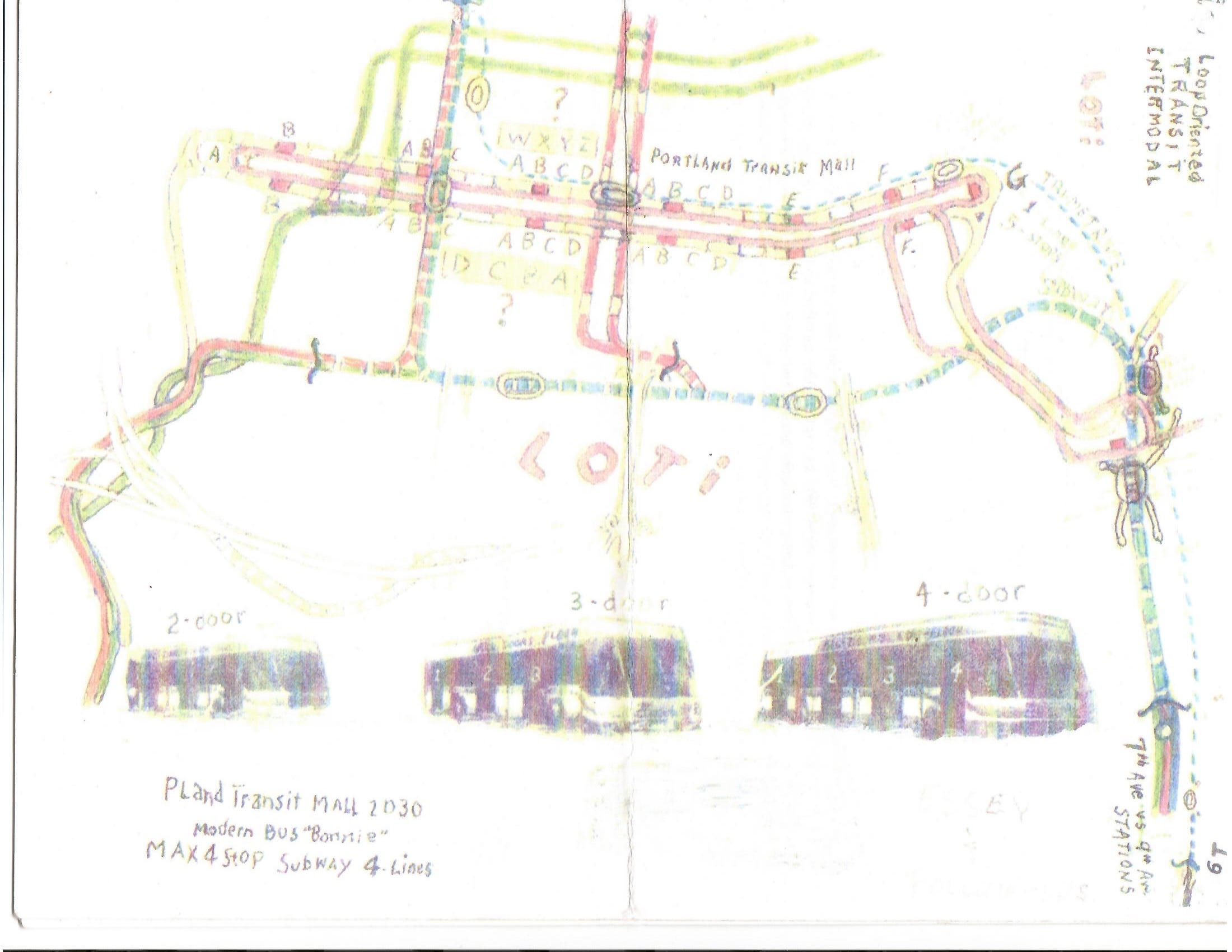
LOTi stands for Loop-Oriented Transit Intermodal, a challenge to traditional radial transit models that funnel all traffic toward a downtown hub.
LOTi envisions looping multimodal corridors or networks, a theory defined by transit researchers in 2024. It fit ideas Lewellan had long harbored.
“One way to refer to LOTI loops is making buses work like streetcars,” he wrote. “A LOTi bus loop can be a mere 1 mile or so in length, with an operational frequency of less than 5 minutes. Denver’s 16th Street Shuttlebus fleet became my model LOTi bus system early on.
“The Shuttlebus fleet there operated flawlessly for 30 years from 1983-2013. Their floor plan is like streetcars, with four automatic doors, entirely low-floors with seating arranged like streetcars for social distancing instead of outdated pairs of seats in two rows designed for high capacity rush-hour demand.”
While TriMet ridership has fallen about 35% since 2012, when annual boardings peaked, and escalating service cuts make most of the news, Lewellan believes a better transit future is possible.
“The application of many LOTi loops throughout whole metropolitan areas has tremendous potential for directing mixed-use infill development, thereby providing residential neighborhoods with new commercial districts, small-scale manufacturing zones, schools that cater to local families, local clinics connected to larger medical complexes, community centers with multiple uses and park space sadly lacking or otherwise inaccessible without a car,” he wrote.
“I’ll repeat, the objective is to create mixed-use infill development models, not merely high-density housing,” he concluded.
Lewellan began serious advocacy for light rail and better transit systems in 1992. President Ronald Reagan had canceled plans, including President Jimmy Carter’s Home Weatherization Tax Credits and broader energy policy goals. After using his carpentry skills toward making more homes more energy efficient, he turned to energy conservation in transportation. That includes electric and hybrid vehicles.
“But not before the public realized its potential and supported new building codes that continue to this day,” he wrote. “In hindsight I can say average homes today are cleaner, more comfortable, healthier, safer and more sturdily built as well as more energy efficient.”
Phil Selinger, a retired TriMet planner, followed Lewellan’s advocacy at public hearings over the years and considered him among a cadre of transit supporters who brought thoughtful ideas to the table. The window for such ideas may be closing. Selinger cannot foresee when transit expansion and innovation get serious attention again.