

By Aubrey Russell
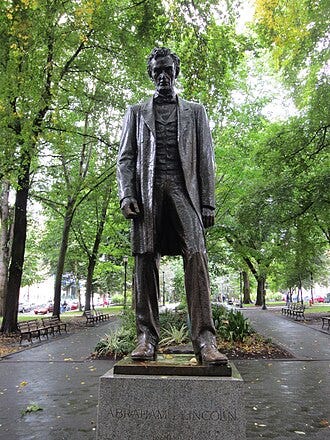
More than five years ago, on Oct. 11, 2020, the monument commemorating Abraham Lincoln in Portland’s South Park Blocks was vandalized and toppled on a day designated as an “Indigenous People’s Day of Rage.”
Within the last few weeks, it was revealed that the city has adopted a plan—at least as early as last year—to not restore the Abraham Lincoln monument to its original condition, but to instead restore the Lincoln statue to a place on the ground, next to—not upon—its former elevated base.
This plan to debase the Lincoln sculpture will come as a surprise to nearly all Portlanders. The act of removing someone from their pedestal has an obvious and universal meaning. An online search tells us that “knocking someone from their pedestal” means: “reducing someone’s ego; to humble or humiliate one.”
We feel that it is wrong for the city of Portland to humiliate Abraham Lincoln, who remains one of history’s most progressive, respected and positive figures. In these times, Lincoln must be a person we try to emulate. We should not desecrate his statue.
The process of reckoning with public monuments commemorating historic leaders is an important one. It is understandable that our country has removed offensive monuments to certain “leaders,” for example. But no city that we are aware of has decided that a monument to Abraham Lincoln should be subjected to debasement. We are not asking our city to discourage the telling of history, but to encourage it through an additive approach to interpretation that educates and enlightens people.
A model for successful public arts policy has recently been demonstrated through the restoration and return of the Thompson Fountain. The city coordinated an inclusive and diverse set of perspectives in celebrating the return of the Thompson Elk Fountain; one which brought a moment of joy, relief and hope to those who have been concerned about the sense of decline in our city’s downtown core.
The Lincoln statue provides a similar opportunity to promote healing in our city by adding to our understanding of history, while leaving intact both the physical monument to Lincoln and the accomplishments that place him at the forefront of America’s progressive movement. Lincoln, in the four short years given him in the White House, preserved the Union, transformed our ideal of liberty through his Gettysburg Address, gave hope to enslaved black people through the Emancipation Proclamation and gave legal meaning to freedom through the 13th Amendment.
When Portland conducted a survey in 2024, the city found that 82% of respondents wanted the Lincoln monument returned. The Office of Arts and Culture had publicly embraced this outcome for years. For the Office of Arts and Culture to now adopt a different course is wrong. We ask that the Office of Arts and Culture put Abraham Lincoln’s statue back on its base, where it belongs. Do not desecrate the statue; make it whole, as promised, once again.
Aubrey Russell is a Portland Heights resident and occasional contributor to the NW Examiner.
People need to be judged by the culture at the moment in time when they lived and their courage and commitment to addressing the most controversial issues at that time. They may have many glaring flaws as judged by today’s standards. But we would not be having the cultural debates today among our voting citizens were it not for Abe. And Antifa would not have existed as it did.
It seems pretty arrogant to tear down heros of our past because they don't meet the expectations of today's young people who just discovered "the truth". The "truth" is much more complicated. We need to learn it, but we don't need to desecrate noble actions of that moved us closer to the vision we hold today of "all men were created equal", articulated by a slave owner for other slave owners and land-owning men who wanted freedom from kings. We build a culture and redefine the vision on the backs of other people in the past that challenged hypocrisy. Thinking that they should have shared our more "perfect" ideals today is a bit silly. It's not how history works.
I am glad there are strong feelings regarding the return of Lincoln to the South Park blocks. But I do not see the “debasement" as Aubrey Russell does nor do I understand who the “we” is that feels "it is wrong for the city of Portland to humiliate Abraham Lincoln.” Nor do I understand why that “we" thinks Portland is humiliating Lincoln by putting him on the ground.
I strongly support the plan of the Office of Arts and Culture to put Abraham Lincoln back in the south park blocks, not on a pedestal but on the earth. I am not aware of the OACs reasoning but to to me, it is a wonderful decision I would like all of us to applaud. Wish I had thought of it. It makes Lincoln meaningful at the very time we need him most. Lincoln would not be comfortable on a pedestal— he said as much when people kneeled or bowed bowed to him. Lincoln in my estimation defines who and what America is —warts and all— an imperfect republic pursuing the beliefs of the Declaration of Independence and an imperfect Constitution. Through most of his life, he was a man of and for the people, conflicted, a public figure living with the people at ground level. He understood divisions that existed. As president in 1861 he never claimed he knew how to deal with the crises he inherited, yet he acted thoughtfully, painfully, opposed and hated by many. But he thought and listened--he evolved. He admitted mistakes. His core beliefs never wavered but they matured, his understanding expanded. By the 20th century no pedestal could hold him. He was in the minds and hearts of publics globally.
The Office of Arts and Culture I hope sticks to its guns and keeps Lincoln on the earth where he belongs. No American leader was more grounded. Let him stand in the South Park blocks, where people can sit with the man while negotiating, struggling with the challenges of their daily lives, and engage more meaningfully with him person to person. Not looking up at him on a pedestal, less approachable, more distant, heroic, perhaps void of flaws-- just another statue ignoring human complexity trying to make a country feel good about itself. In Portland today an iconic Lincoln on a South Park pedestal is not enough, I want to get him down on the ground, have a conversation with another Portlander about who Lincoln was, the complexities, leadership, a human being big enough to be inconsistent as WEB Dubois put it, with understanding, political integrity and courage—a global need in our 21st-century. And a major need in America 250.
Elliott Trommald