


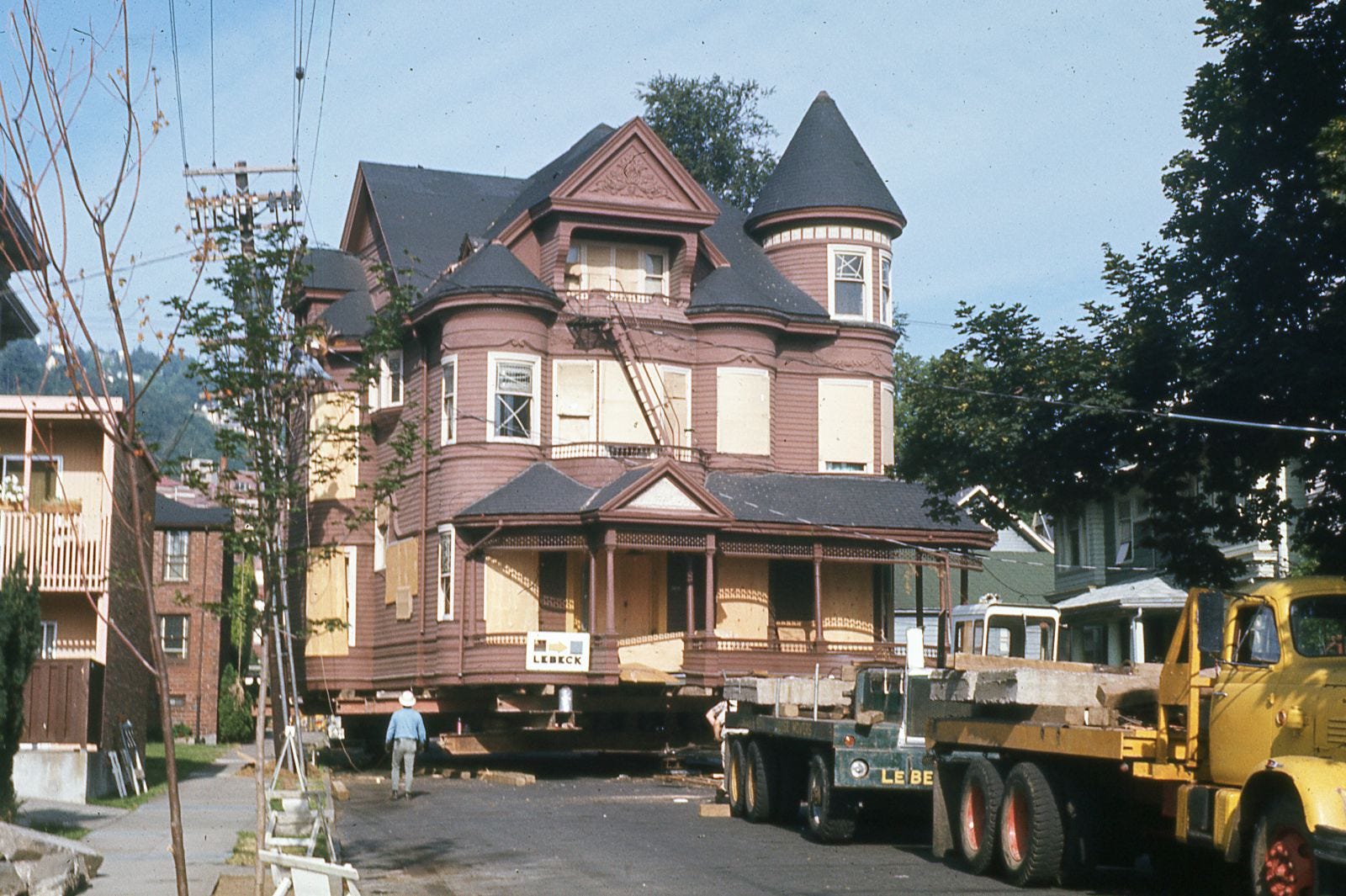
The Capt. John Brown House was considered one of the finest remaining examples of Victorian home design in the city in 1968. It was on the National Register of Historic Places. Yet within five years, it was gone, though it didn’t go down without a fight.
Local historian Tanya Lyn March will tell the story of ill-fated efforts to save some of the city’s historic treasures in a lecture at the Architectural Heritage Center, 701 SE Grand Ave., June 13 at 10 a.m. Notable exceptions to the list of lost causes include the Kamm House in Goose Hollow and Ladd Carriage House in downtown.
But the challenge of saving, moving and restoring a 19th century house can be seen through the John Brown House saga.
It was built in 1898 on Northwest Everett Street.
March notes:
It was designed by architect Thomas J. Jones (1853-1921), who was born in Wales and arrived in Portland in 1887. He served on the City Council (c1895) and designed the old Washington High School and Portland High School as the school district’s supervising architect in the early 1900s.
In the 1968 edition of his book, “Nineteenth Street,” Richard Marlitt wrote: “Here is one of the few good examples of a Victorian house that is left in the city. … The heavy dormers, the tower shooting out of the circular porch, the disdain for proportions, are all architectural earmarks of the [1880s]. There is a playfulness and daring in the design of this house like this for it rather typifies the brash ways of showing success at that time.”
“The community rallied with the dream of saving the Captain John Brown House,” March wrote. “The home was moved to land owned by Portland Public Schools.
“The initial goal, following a successful private fundraising effort and a $100,000 grant from the Department of Housing and Urban Development, was to fully restore the building as a senior and medical center.
“However, the funding was not sufficient. After the home was moved in 1970 to the northeast corner of Couch Park to save it from demolition, fundraising efforts stalled. William Hawkins and his team drafted a forward-thinking adaptive reuse project, but their architectural plans gathered dust.
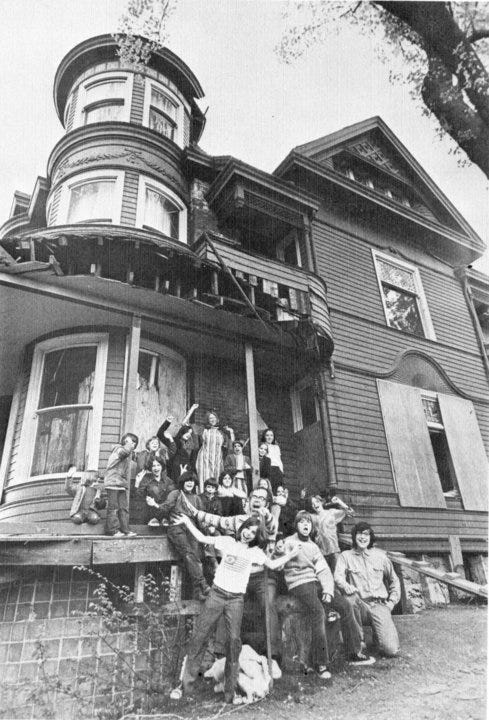
“After the move, the structure rapidly deteriorated. ‘While in limbo, [the house] was generally ignored,’ Marlitt wrote.
“Within two years of the move, vandals had ‘wreaked such havoc on it that the structure was deemed fit for little else but demolition.’ It was demolished in 1973.”
March will also explore the mid-move calamity of the Ahavath Achim Synagogue,
March holds a Ph.D. in urban studies from Portland State University and a master’s in historic preservation from Columbia University. As the founder of Slabtown Tours, she specializes in uncovering Portland’s hidden histories.
Tickets to the lecture are $20 for AHC members and $30 for the nonmembers. For information, write to info@visitahc.org.