



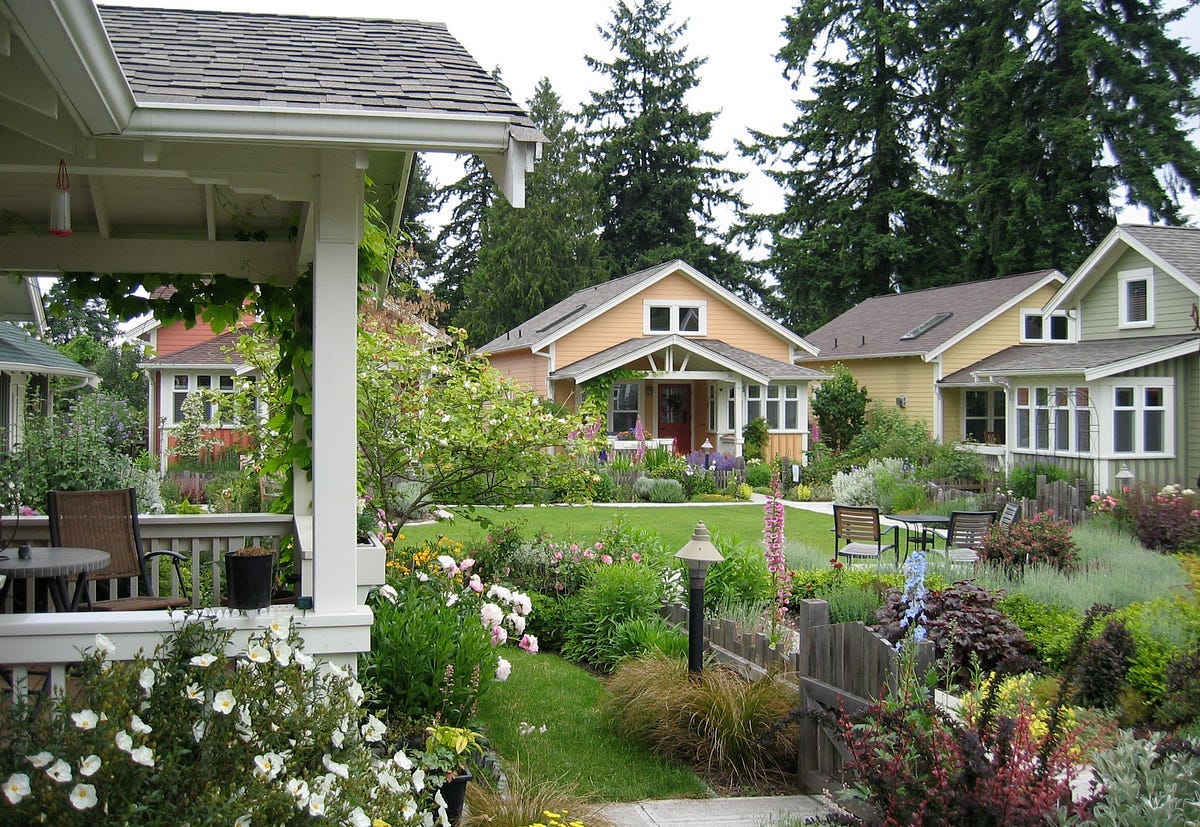
As Portland home construction has stalled, and cranes no longer dot the skyline, city officials are thinking small—“cottage clusters” of small detached houses squeezed into heretofore single-family lots.
These are not the cute, closet-sized “tiny houses” that capture the imagination. In fact, few would describe them as cottages, though they are smaller than most new homes. The space reduction is accomplished primarily by sharing minimal outdoor space and eliminating off-street parking.
Last March, the Washington Post wrote “Portland has a wonky secret to building cheaper houses.”
Portland incentivizes these clusters by boosting the allowable square footage on a lot and exempting them from design review if they meet certain standards, such as 900-square-foot maximum building footprints and at least 750 square feet of common yard.
Most cottage clusters in the area so far have been on the eastside of the river, but the first Northwest Portland example is coming to 2857 NW Savier St., where a 1908 house is being dismantled to build four houses, each three stories tall and containing 1,450 square feet.
“This is what the city wants,” real estate broker George McCleary told the NW Examiner.
McCleary, who grew up in the Hillside neighborhood and owns McCleary Realty & Development, is representing the property owner, HD Clinton of Southeast Portland, who bought the lot from the heirs of the woman who lived in the Savier Street house many years before her death last year.
McCleary advised the heirs that the 1908 house, though rundown, could have drawn an attractive price as a “fixer.” But he said they wanted the higher return made possible through the cottage cluster program. They initially listed the property for $300,000, but as a cluster site, it went for $540,000.
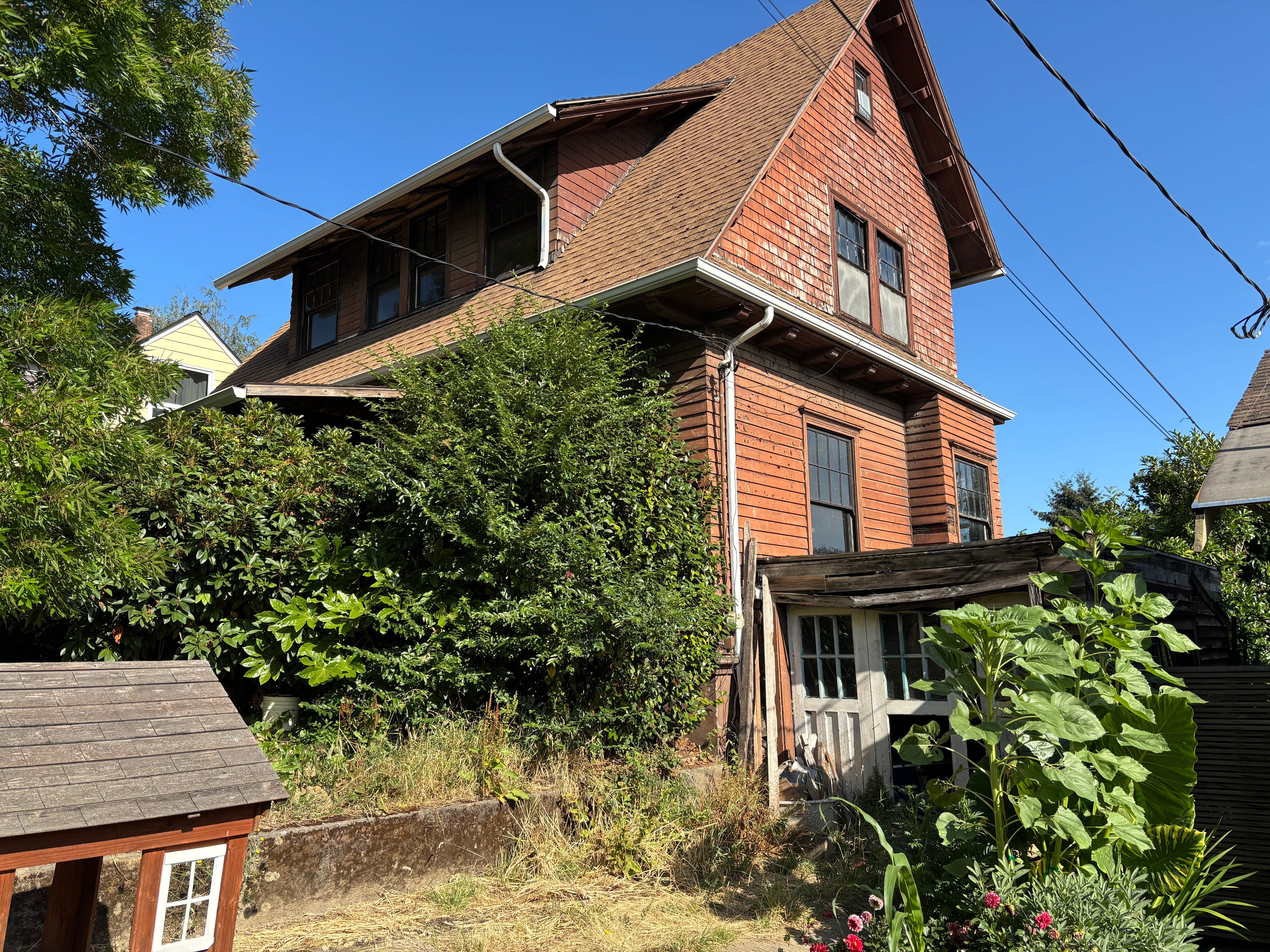
“If the dirt is worth more than the structure on it, we should not be surprised,” he said. “This is what is coming down the pike.”
McCleary said the target price for each house is $700,000-$800,000.
Two adjacent neighbors are not pleased.
“The lot will be entirely subsumed by the buildings, and we are all sad to see that they have made no attempt to fit into the neighboring houses from any architectural standpoint,” Joni Johnson told members of the Northwest District Association Planning Committee, of which she is a member. “They have pushed the height limit to the edge of the code.”
The 25-foot height limit would not normally accommodate three stories, but the top floors are measured at the roof’s midpoint rather than its peak.
The other neighbor, Greta Hillbourne, said, “It’s disappointing to see what’s going to happen to our happy little block. They’re calling it a cottage cluster, but it’s four three-story houses. There’s no off-street parking, and there’s very little storage in the units. We’re going to end up with four homes that nobody is going to want. They’re just awkward; they look straight into each other … and a lot of neighbors are concerned about the parking impact.”
But a city and state committed to adding more housing see cottage clusters as a way to achieve “a middle-housing alternative designed to increase affordable, lower-maintenance homeownership in walkable urban areas,” according to the Portland Bureau of Planning and Sustainability website.
BPS reports that “a study released last year found that middle-housing production has grown significantly since these zoning changes were adopted.”
BPS could not provide a count of completed cottage cluster projects but cited four examples in North and Northeast Portland. Many more are in the application phase.
A BPS graph shows annual housing construction permits, which have declined from 1,032 in 2018, bottomed out in 2020 and are rebounding to more than 700 per year since cottage clusters were allowed in 2023. Cottage clusters are now the most popular option on single lots, far surpassing conventional single-family houses.
Cottage clusters are one of the “middle housing” strategies evolving from the city’s 2020 Residential Infill Project, which expanded development rights in single-dwelling zones. The latest cottage cluster definition requires five homes per lot.
Chris Mackovjak, a Realty Portland broker in the Pearl, sees potential in cottage clusters. On his website, which lists 17 projects in the general category, he discusses the trend extensively.
“They’re called cottage clusters, and they’re shaking things up a bit. … I’ve noticed them getting traction as more and more buyers learn about them,” Mackovjak wrote.
Price is a selling point. His 17 recent listings range in price from $314,900 (for a 671-square-foot house) to $510,000 (for 2,093 square feet).
“The reason these homes are less expensive is because they’re small. It helps to think of it as a two-bedroom high-rise condo that has been turned into a two-story tiny home, because the storage and dimensions will be similar.
“You might be surprised how different it looks from the listing photos. I’ve had clients 100% sure they were going to buy the one they saw online only to change their mind when they actually stood in the unit,” he wrote.
Asked if cottage clusters are the next big thing and an antidote to the housing shortage, Mackovjak told the Examiner, “I would give it a ‘to be determined.’”
Darryl Bodie, a broker with Keller Williams Realty who has sold over 5,000 Oregon properties in 26 years, said cottage clusters are expanding home ownership opportunities.
“Now someone can buy a home that isn’t a condo,” Bodie said, and at prices as low as $320,000.
“We’ve sold 500 units per year the last three years in a row, and 80% of them have been middle-housing,” he said.
Not all of the approximately 400 homes he referred to were in cottage clusters. He included duplexes and other multiunit configurations enabled by the Residential Infill Project, but he still considers cottage clusters an “important” option.
Important, but perhaps not the breakthrough policymakers believe they are.
“We have 200 units available, and there’s not a lot of people buying them,” Bodie said. “To say that we need more units is nice—and I’m sure the developers appreciate it—but that hasn’t necessarily created affordability.”
Make a mess of a nice block because a property owner is greedy. Then have the city call it building a better future for all.
On what planet is $700-$800k “affordable”? This is a developer’s dream, handed to them by the city.