


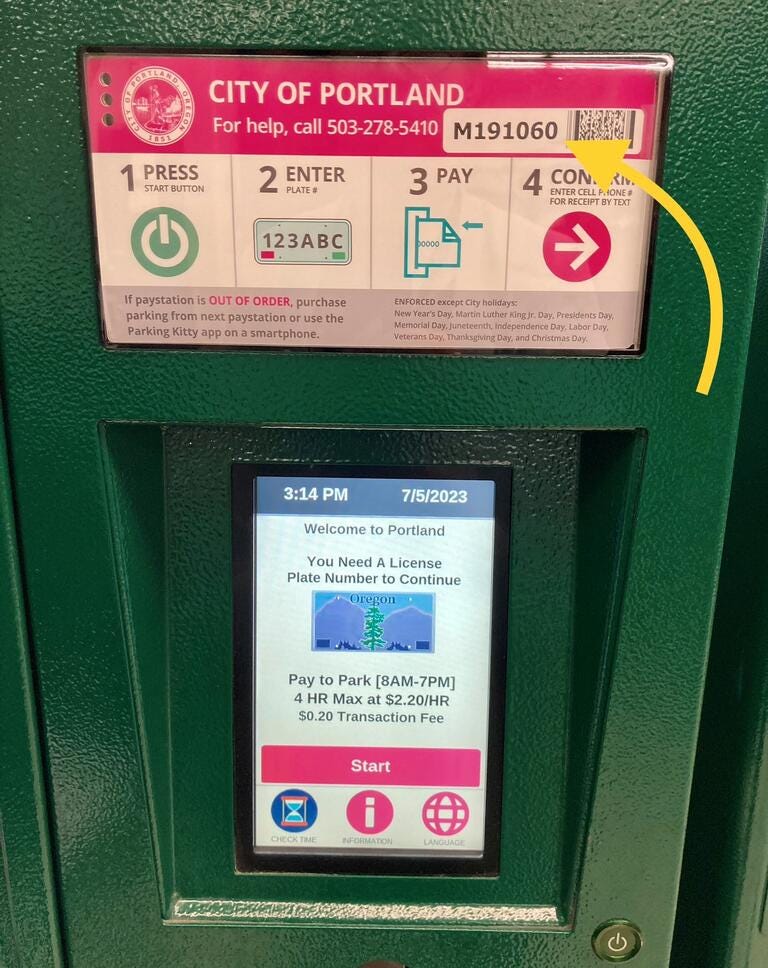
Prices are rising everywhere, including the cost of citizen input. Even so, overhead costs assigned to a committee of Northwest District residents advising the Portland Bureau of Transportation on local projects is extraordinary.
Under an agreement adopted by the Portland City Council in 2013, half of the net revenues from meters and permits in the zone are set aside for transportation enhancement projects chosen by the committee. But that half also has to cover PBOT staff who facilitate the monthly meetings of the Stakeholders Advisory Committee and implement projects.
And PBOT overhead keeps rising. In September, PBOT presented a budget increasing staff costs from $195,000 per year to $491,842.
Parking District Manager Liza Farr explained the jump.
“When Stanley [Ong] or I spend an hour working on something for the Northwest Parking District … that hour gets billed to the parking district.”
Now PBOT intends to add employee benefits and a share of PBOT overhead to those hourly rates.
“The benefits rate is 98%, and the overhead is 89% on top of that,” Farr said.
Outside consultants who facilitate the monthly meetings or do research are also costing more.
“We have gone through another competitive procurement process, so this new contract has their updated rates based on seven years of really bad inflation, so that is why that is so much higher. It’s all the same work, it’s just seven years of inflationary costs all at once,” she said.
“It ends up being almost four times the [old] rate,” Farr said.
“Almost four times,” Ong confirmed.
“It’s been a moment of reckoning for us, too,” Farr said. “We did not hide this from you, I will say that.”
SAC members took the bombshell calmly, none questioning the premise that the dedicated neighborhood funds should be burdened with a share of the bureau’s overall operating costs.
“That’s a big adjustment upward in staff [costs],” SAC Chair Amy Spreadborough said. “It’s basically increasing three times what was originally budgeted.”
“We’re here to advise PBOT on our recommended priorities for projects that can bring value back to the community … so it would be helpful to understand what kinds of activities that we ask for trigger the use of staff time. We’d be more hesitant to have you guys go and explore or research something that we could spend our dollars not knowing that’s going to rack up.”
SAC vice chair Todd Zarnitz added, “What isn’t being said is that the city’s in a severe budget crisis, and this is one of the many ways that we’re going to be seeing attempts to plug a lot of these gaps.”
Costly though it may be, Zarnitz credits PBOT staff for surmounting past divisions that led to the city unilaterally shutting down the committee for six months in 2023-24.
“This committee has drastically changed in character, in tone and in people involved,” he said. “It’s definitely moving in the right direction. … That team has been a significant contributor to putting us in a better direction. … We can talk about the costs involved, of course, but we also have to recognize the contributions.”
SAC member Victoria Via also took a sympathetic stance toward PBOT’s budget woes.
“The other aspect … is looking into increasing revenue,” Via said. “When we have discussions about increasing parking rates, that has always been a really challenging and tricky conversation. But now looking at the budget and understanding all of the things that we want to do … is it worth increasing rates?”
A benefits rate of 98%??? That’s a first in my experience.
Under the theory that parking spaces exist only for those who have cars and for those that depend upon those who have cars for transportation. That means those who come downtown or low park areas for government services, to attend museums or libraries or eat at restaurants or shop at businesses or visit friends who live downtown or provide public services. These are stakeholders. I understand that public transportation does exist but is suffering because many who use it don’t pay and it is unsafe. Are we going to start charging public policy advisory committees for public safety for their participation?
This seems more like a war by government on volunteers because they have interest not shared by government or by their public employee unions. It would be interesting to know the overlap between Portland’s and Multnomah County’s public unions and DSA membership.