


COLAB Architecture + Urban Design’s office sits inside a ground floor condominium at the Vista located in the Pearl’s quieter north end.
The firm, led by Mark Engberg, has designed contemporary, high-concept buildings in Dubai and Cairo, as well as Portland buildings such as the Willamette Sailing Club facility on the river’s east bank. Tube and the Agency Sports Bar, both now closed, were also COLAB bar/restaurant projects.
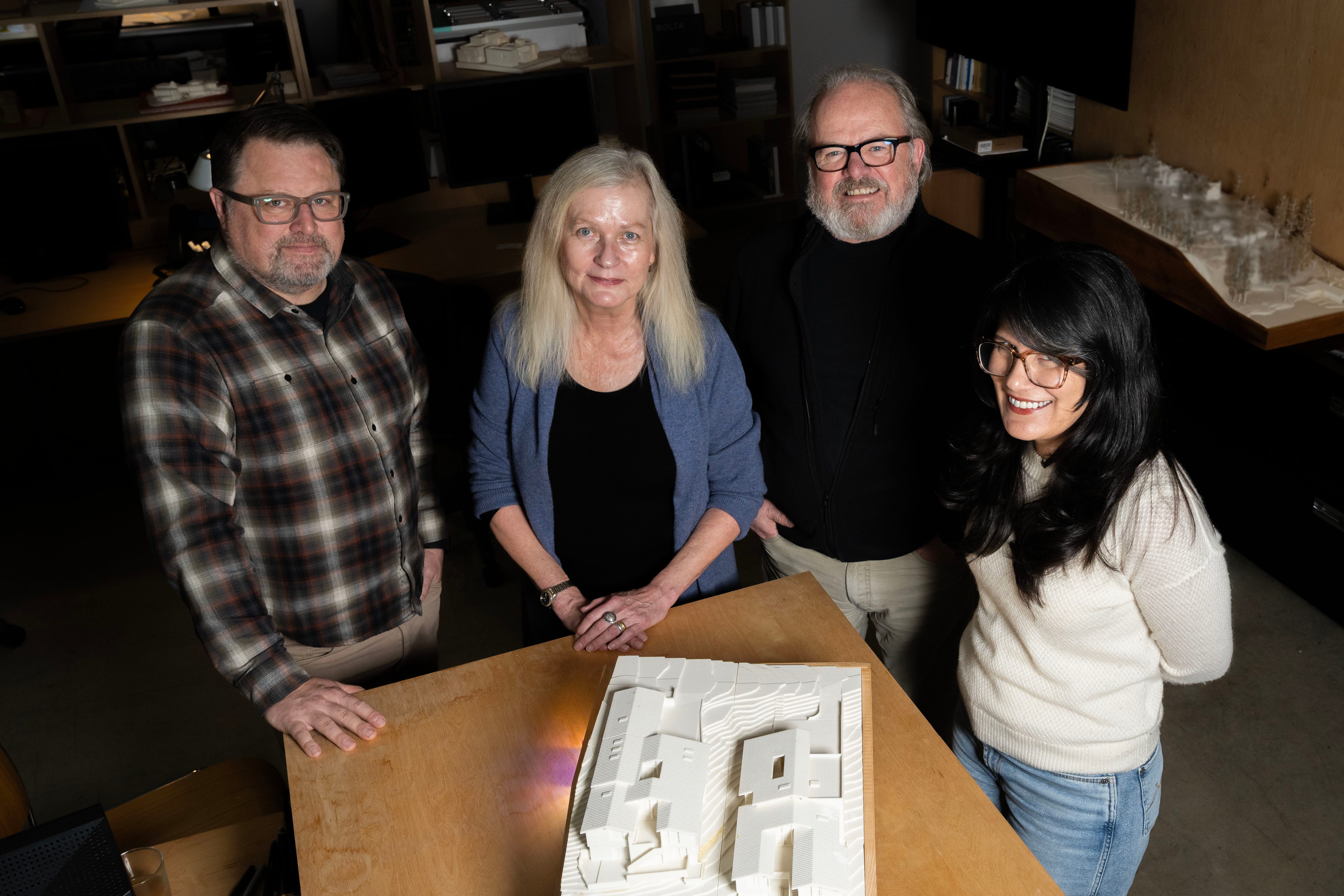
Engberg affectionately calls COLAB “the weirdest little architecture firm” in town. For example, it’s currently working on a high-efficiency greenhouse run by robots, a kind of large-scale salad center. As climate change destabilizes the food supply, farms sited close to cities will be needed to grow lettuces and other vegetables. The Netherlands is the global hub for this type of all-mechanical, year-round farming; the greenhouse COLAB is designing will be located in the United States.
Engberg was asked what he thought about the long-awaited development plans for Centennial Mills.
“Not bad. Not great,” he said. “At least these are mid-rise buildings and not high-rises. But what a boondoggle the city sold it for a song.”
Still, something at this location is better than nothing, he said, and because the developers plan to provide a landing for a foot bridge to connect the Fields Park to the waterfront, it’s a win for Portlanders.
During Covid, Engberg and his wife designed and built a house at Arch Cape on the Oregon Coast, where they live part time. They’re also working on a two-story building with apartments on Manzanita’s main drag, Laneda Avenue.
He notes the thrift store prices for Portland’s iconic buildings as a worrisome sign for the local economy. Portland’s U.S. Bankcorp Tower, or Big Pink, cost only $45 a square foot. “And they threw in an 11-story parking lot for free,” he said.
Another example is the Hugh Stubbins-designed 30-floor PacWest Center that sold for $55 million or $102 a square foot. A steal even in a downturn. To compare, Engberg said, “a very basic stick house would cost about $300-$350 a square foot.”
The next question for Portland will be how to convert empty offices into housing if people aren’t returning to their offices more regularly. The absence of people numbs the city while small businesses and civic life suffers, he said.
“It’s so boring. People staying in all day long on computers ordering from Amazon in their pajamas,” Engberg said.
Take the space next door to COLAB as an example. It’s been used as storage by an out of business French furniture retailer and has been collecting dust since before Covid.
“People wander in and ask about it, though,” Engberg said.
The NW Examiner article presents architect Mark Engberg’s views on the redevelopment of Centennial Mills and on Portland’s broader urban challenges. Two recurring themes—relief that the new proposal avoids high-rise construction and the suggestion that office-to-residential conversion should become a central strategy—reflect assumptions that warrant closer scrutiny.
1. The Dismissal of High-Rise Development as an A Priori Good
Engberg’s approval that the Centennial Mills plan omits high-rise buildings reflects a normative preference within Portland’s architectural culture rather than an evidence-based evaluation of the site. In urban planning terms, the Centennial Mills parcel is one of the few west-side waterfront locations ideally suited for vertical residential development: it is isolated from low-rise neighborhoods, adjacent to a major park, and capable of supporting density without adverse impacts on established areas.
High-rise housing in such a location offers significant advantages. It concentrates population near the urban core, supports retail and transit, yields higher tax revenue per acre, and makes efficient use of scarce waterfront land. Cities with strong downtown residential populations have been more resilient in the face of shifting office patterns; height, in this context, is not merely a design choice but a structural tool for stabilizing civic life and economic activity. The automatic preference for mid-rise structures therefore limits the city’s ability to address its stated goals, and the article presents this preference without examining its implications.
2. The Overstated Promise of Office-to-Residential Conversion
Engberg’s remarks on office-to-residential conversion similarly reflect a widely circulated but technically constrained idea. While the concept has gained national attention, its feasibility depends heavily on building typology. Most of Portland’s modern office towers are characterized by deep floorplates and mechanical layouts that do not accommodate residential unit depth, natural light requirements, or the vertical stacking of plumbing. As a result, only a narrow segment of the city’s office stock—primarily prewar or early mid-century buildings—is convertible at scale. Emphasizing conversion as an impending priority risks overstating its capacity to meaningfully address downtown decline while diverting attention from more viable strategies.
3. A Conceptual Mismatch Between Problem and Proposed Remedies
Taken together, the two positions reveal a structural tension. If high-rise residential development is implicitly discouraged, and office-to-residential conversions are largely infeasible for the majority of the building stock, then the pathways for repopulating and revitalizing Portland’s core are severely constrained. The article treats each view as independently reasonable but does not interrogate their incompatibility.
Conclusion
The positions articulated in the article reflect broader tendencies within Portland’s planning and architectural discourse: a skepticism of height and an optimistic emphasis on office conversions. Both assumptions require more critical evaluation, as they shape public expectations about what forms of development are possible or effective. A clearer alignment between desired urban outcomes and the physical tools available to achieve them is necessary if Portland is to address its long-term structural challenges.