


Updated Aug. 1
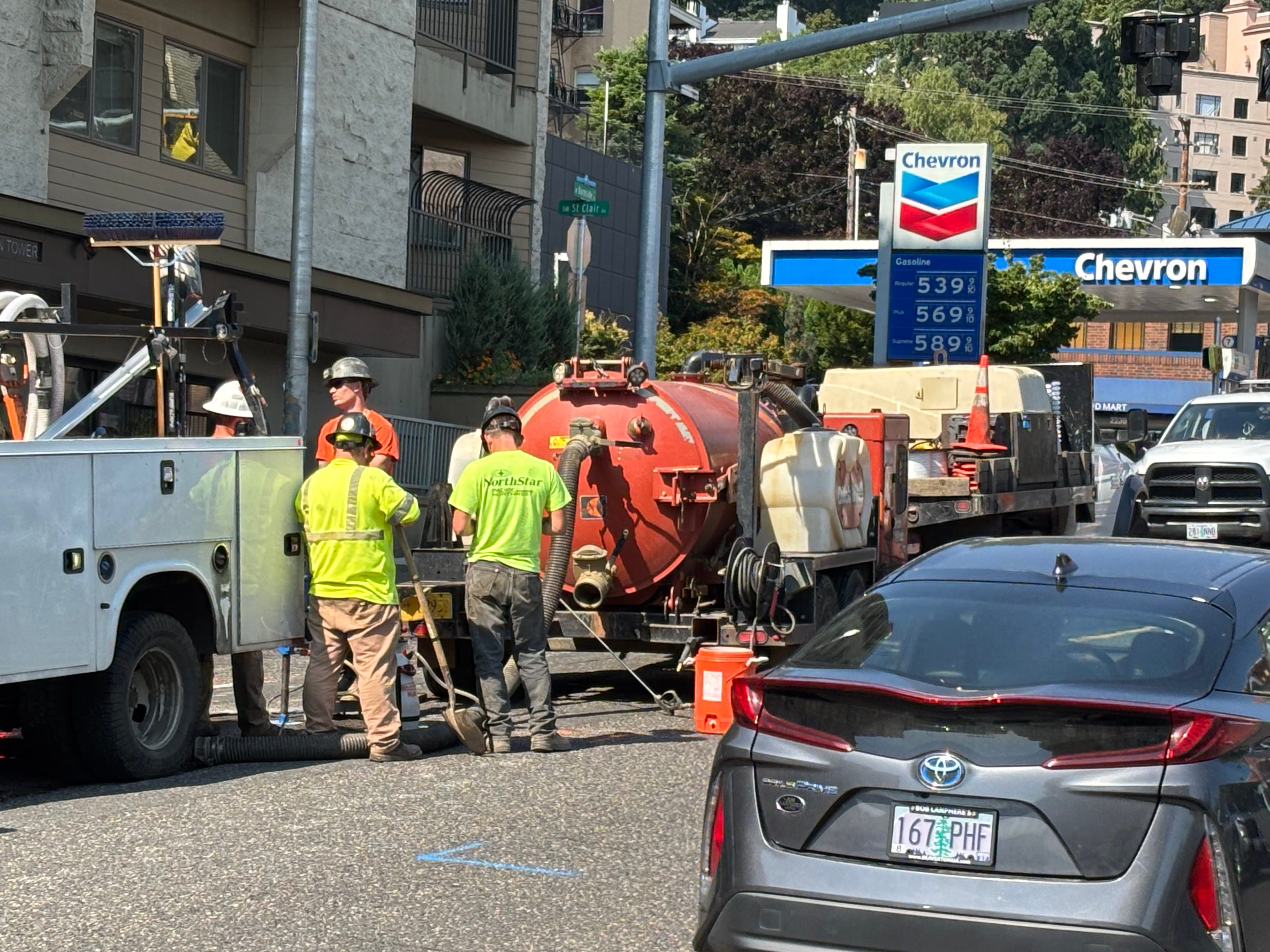
For those who waited decades for rutted Northwest 23rd Avenue to be repaved, the resurfacing of West Burnside Street came on suddenly—too suddenly for activists in the Better Burnside Coalition, who are calling for a major redesign of the city’s primary east-west artery.
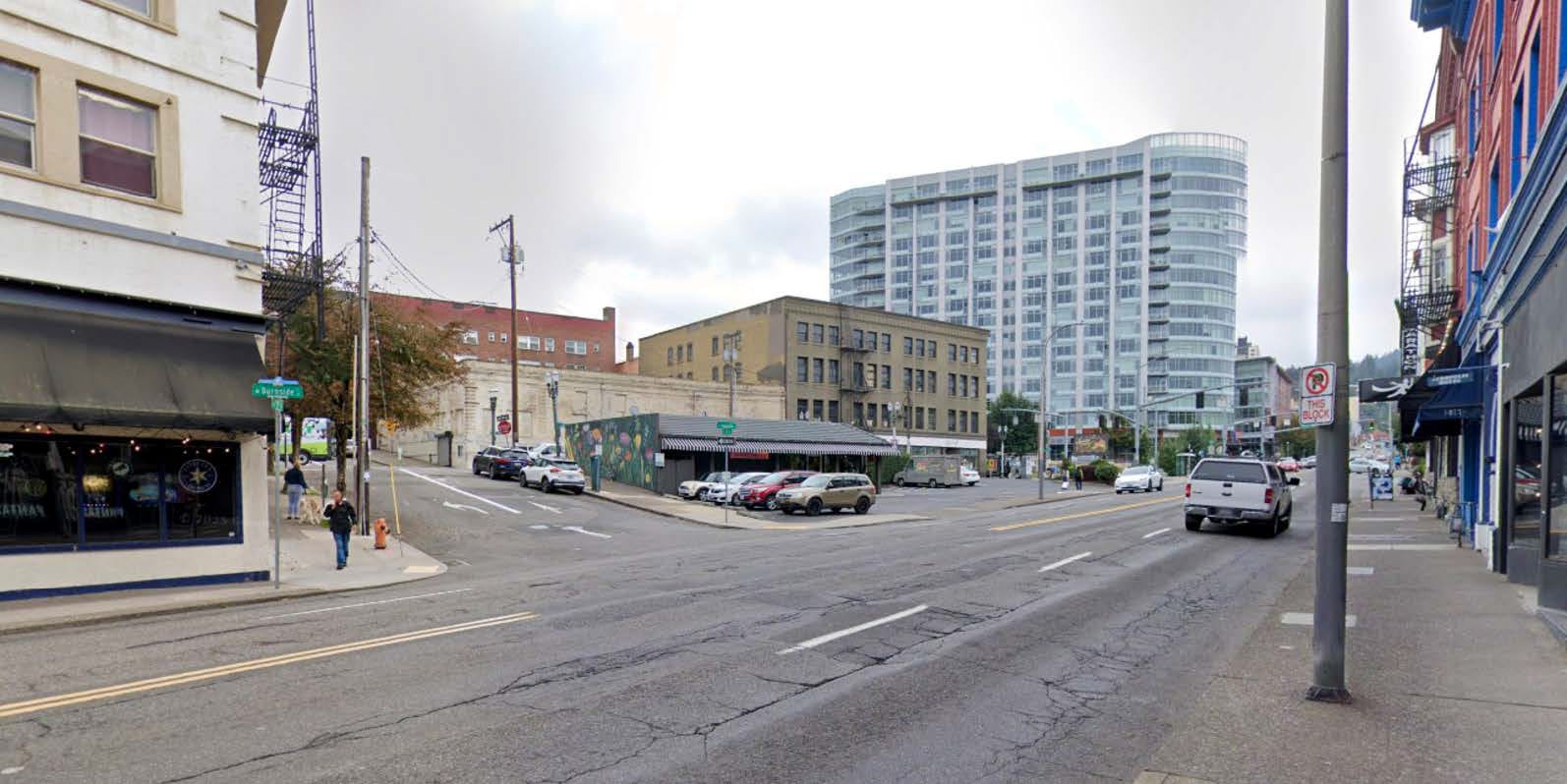
“The sidewalks are narrow, the traffic is fast, the crossings are dangerous and the bus stops are difficult to access,” read a letter to the city signed by Better Block PDX Chair Ryan Hashagen and a list of alternative transportation groups and neighborhood associations.
Repaving “is the ideal time to add improvements that would enhance both the economic vitality and the safety of the street. PBOT is planning on restriping West Burnside using the same lane configuration that it has now, without addressing the unpleasant and dangerous conditions,” the letter continued.
“This is a huge missed opportunity that threatens to lock Burnside in as a high-crash corridor for the next 20 years. It’s also a departure from PBOT’s cost-saving practice of leveraging funding to address ongoing maintenance and safety goals together.
“Even worse, PBOT is planning on starting this restripe and associated ADA ramp upgrades in the very near future, essentially preventing the community from having any say in the future of this major corridor.”
The coalition seeks to pause the project for “a community conversation that ensures that West Burnside works for everyone.”
Coalition members are also suspicious as to how the repaving project rose above earlier prioritized transportation projects: “How did this project get identified and moved to the top of the project list?”
District 4 Councilor Olivia Clark, who chairs the council’s Public Works Committee, has gotten the message.
“We need to stop and have PBOT take another look at it for a more comprehensive approach,” Clark told the NW Examiner. ”I believe safety considerations should be our No. 1 concern.”
The next day, she added: “while being conscientious about asset condition.”
The amendment was a nod to her core principle that the city’s physical assets must be managed for long-term stability and financial prudence.
District 4 Councilor Mitch Green was stronger in his denunciation of PBOT’s approach to West Burnside at the council’s July 23 Finance and Governance Committee meeting.
“I’d like to hear a little bit more from Deputy City Administrator [Priya] Dhanapal and the city administrator … on why we’re proceeding on a paving project like this,” said Green, who called this a project that doesn’t include modest investments to address the threat of pedestrian deaths.
“This is not Vision Zero,” he added, referring to a 2016 city program to reduce traffic deaths.
PBOT answers
What is PBOT’s justification for paving now and engaging the community later?
“This project was added to our paving list as part of a broader PBOT effort to resurface important corridors—such as the recently repaved segment of Northwest 23rd— where we have struggled to self-perform pavement maintenance in the past,” wrote PBOT Communications Director Hannah Schafer.
Schafer said the paving “will not preclude future safety or transit priority work on the corridor” and “we are considering additional community input” on later phases of the project coming next year.
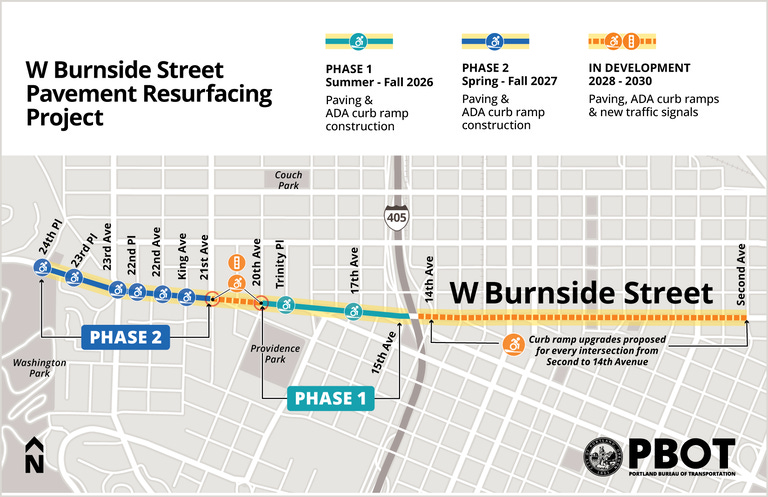
PBOT breaks the project into two phases:
Phase I, to be completed by mid-October, includes repaving and new ADA ramps between 15th and 20th avenues
Phase II, in 2027, involves repaving and new ADA ramps between 22nd Avenue and 24th Place.
“We share the community’s assessment that West Burnside has many needs beyond the pavement condition,” Schafer wrote. “While this maintenance project is not scoped to address all of them, the bureau has made meaningful investments in safety, accessibility, and bicycle and pedestrian connectivity on the corridor.”
Those improvements include extending the eastbound bus lane from Fifth Avenue to the Burnside Bridge and extending bike lanes in both directions between Fourth Avenue and the bridge.
Further plans involve extending the eastbound transit lane to 10th Avenue.
Better Blocks
Many of the Better Burnside Coalition forces were also behind the Better Naito Project of 2015, which replaced vehicle lanes with protected bicycle lanes in downtown, Old Town and the Pearl District.
Both local campaigns have been fostered by the Better Block Foundation, an “urban design organization based in Dallas, Texas, that empowers communities to reactivate and reshape their built environments. It uses temporary, hands-on, low-cost demonstration projects to improve walkability, bike safety and neighborhood vibrancy.”
A pause to consider more comprehensive approaches is also supported by urban planning graduate students at Portland State University, where a Better Burnside design workshop was held on March 11.
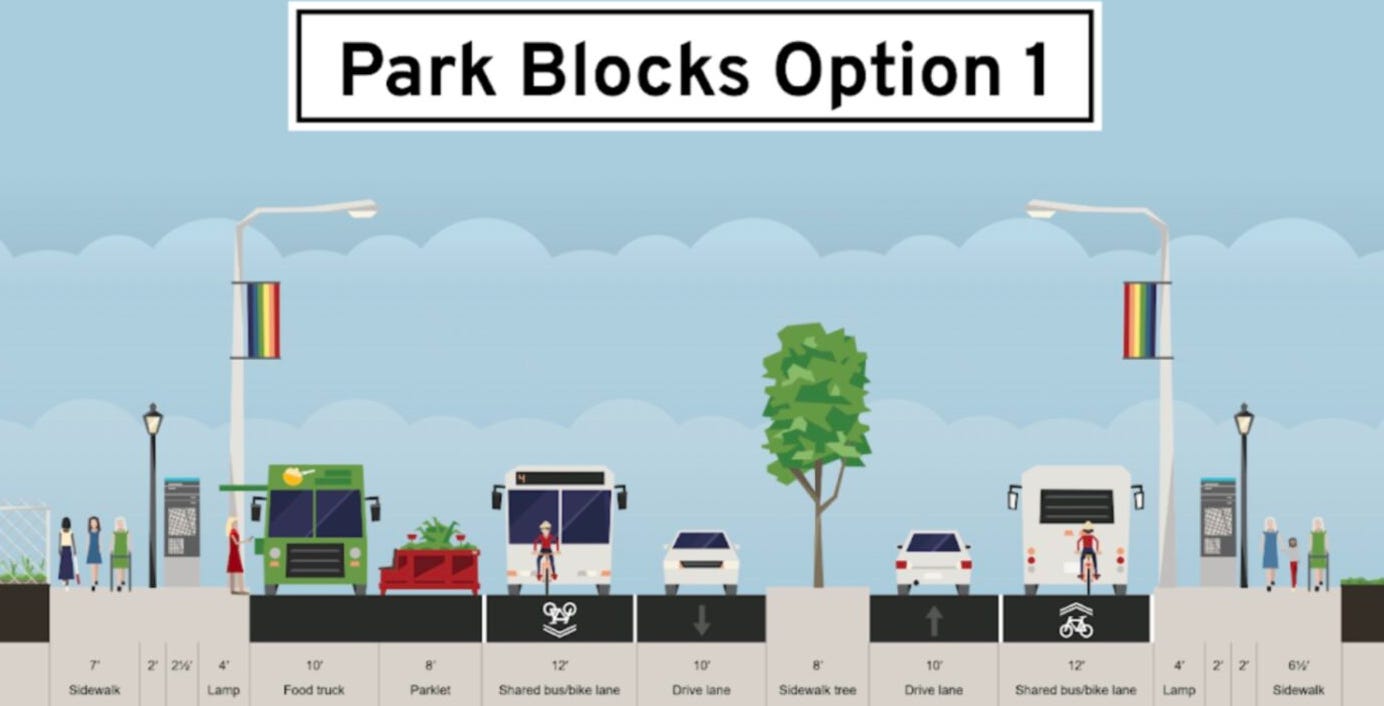
The Better Burnside vision for the Park Blocks area includes wider sidewalks, a food truck and “parklet” lane, a shared bike/bus lane but only one vehicle lane in each direction.
The Better Burnside Coalition is seeking:
Project cost and schedules,
Source of funding,
Engagement of the public, neighborhoods and stakeholders.
Four Burnside-adjacent neighborhood associations have endorsed the coalition’s position. Representatives of Old Town Community Association, Downtown Neighborhood Association and Pearl District Neighborhood Association were identified as initiators of the Better Burnside campaign by a PSU report on the March workshop.
PDNA has not yet endorsed the plan, though the Goose Hollow Foothills League and Northwest District Association signed on last month.
The city of Portland Pedestrian Advisory Committee also supports the Better Burnside Coalition goals.
“We were surprised and disappointed to hear that the city is moving forward with a major investment in repaving West Burnside without a public input process [or] a presentation to the PAC,” wrote the body’s co-chair, Tabitha Boschetti.
By allowing higher driving speeds, smoother paving may even work against safety, in her eyes.
“Ironically, bad paving works to slow traffic, whereas new paving is often associated with higher speeds. West Burnside is already an unsafe and uncomfortable street for people walking, bicycling, riding motorcycles and driving,” Boschetti wrote.
Though making a passing reference to “economic vitality,” the Better Burnside Coalition is not focused on the declining state of retail along the street or on the impact of crime or people sitting/lying on the sidewalk.
NWDA President Todd Zarnitz made those points in a separate letter in support of a pause for community input.
“Currently, the corridor is configured solely to prioritize vehicle speeds at the expense of safety, economic vitality and neighborhood cohesion,” he wrote. “As a direct result of this design, local businesses struggle to survive, and the corridor invites disorder and crime that further widens the division between our neighborhoods.”
Paving not enough
On July 27, PBOT Director Millicent Williams was interviewed on Oregon Public Broadcasting’s Think Out Loud, throwing a curve that hints of a shift in bureau thinking.
“We were just going to repave Fourth Avenue, and then we saw an opportunity to create a bike boulevard, we had an opportunity to work with the transit system to enhance how transit moves through that corridor, we saw the opportunity to create greater access to pedestrians in terms of wider sidewalks and upgrades to all the ADA ramps,” Williams said.
“We cobbled together local funding, as well as partner funding, as well as state funding, as well as some grant funding to make a complete project. We’re working to make sure we’re doing that in as many instances as we can.
“To just pave is not quite enough. To just put in a new signal is often not enough. How do we marry the paving, how do we marry striping, how do we marry pedestrian access together with bike infrastructure to ensure that we’re creating a complete project?”
This dispute is about more than whether PBOT should repave West Burnside before holding another round of public meetings. It raises a larger question that Portland has never plainly put to voters: Do a majority want the city to make driving slower, less direct, less convenient and more expensive in order to discourage car use?
That has become the city’s de facto policy through climate targets, transportation plans, PBOT standards, grant applications and individual street projects. Lanes are removed, turns are restricted, parking is reduced and road space is shifted to other uses. Each change is presented separately, often as a safety or technical decision, but the combined effect is to make driving less attractive.
The Better Burnside proposal may have merits, but reducing vehicle capacity on a major arterial is a policy choice, not merely a design detail. It should be debated openly by elected representatives, with clear information about travel times, traffic diversion, business access, transit, safety and cost.
By the time the public is usually invited to comment, the basic goal of reducing automobile capacity is treated as settled. That is backwards. Motorists do not have to win every dispute, but they should be treated as voters and taxpayers whose time, mobility and access matter.
Voices not being heard or ignored seems to be a recurrent theme. Hmm, is this only Portland or are these themes observed elsewhere? More so in Democratic Party run cities?
A major East-West corridor has already been physically established. Changing its dynamics would have serious traffic buildup prospects.
Lastly, pedestrian deaths: what is the frequency? Is there a consistent reason for their occurrence? What is the experience in less traveled streets?