


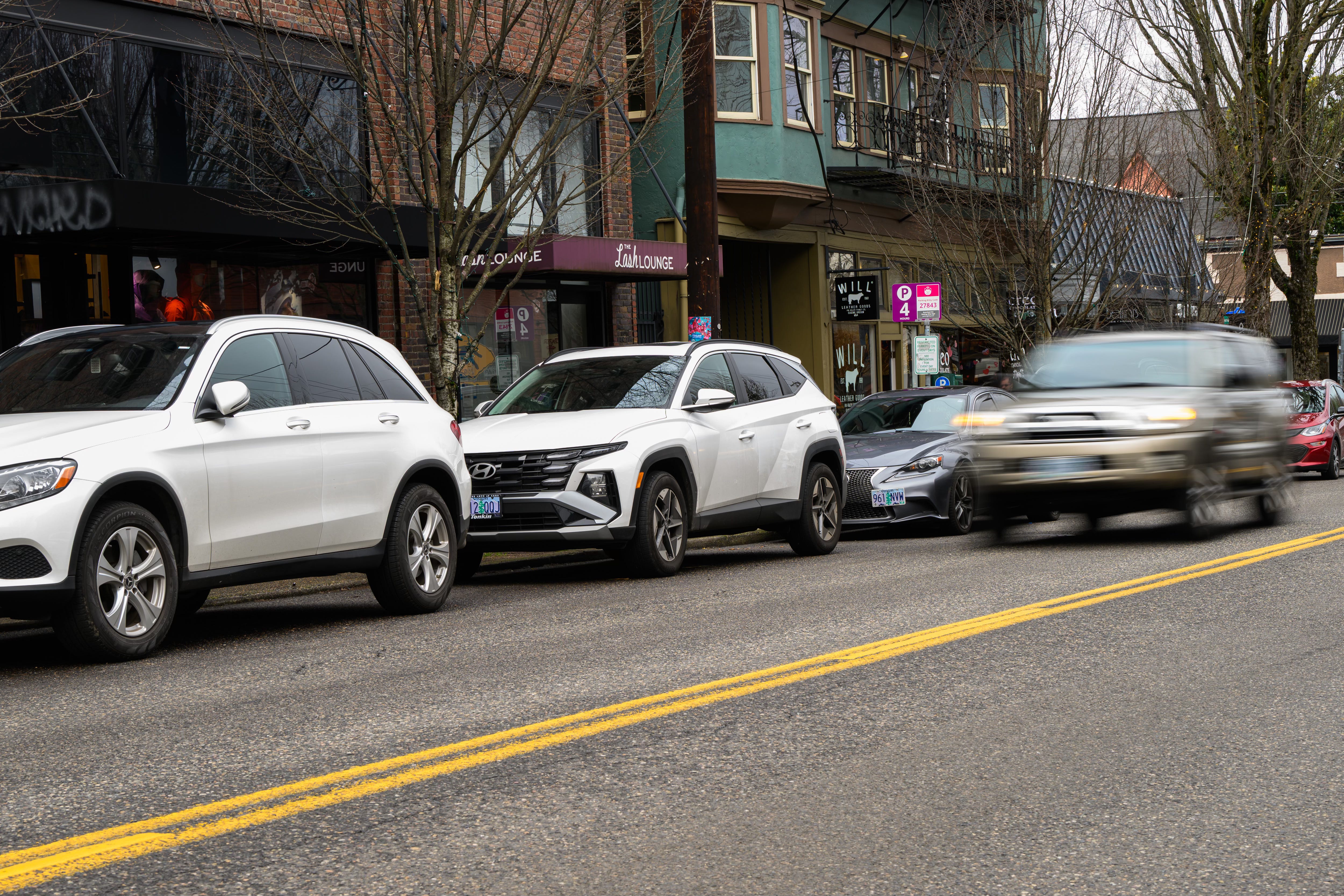
The peace treaty ending decades of “parking wars” in the Northwest District was keyed on a basic tradeoff: To relieve parking congestion, on-street parking could no longer be free. Shoppers and visitors would have to feed meters, and residents would buy annual permits exempting them from meter charges.
Incentivizing motorists to vacate spaces more quickly would create turnover and more efficient use of available curb space, it was agreed.
The City Council ratified the deal in 2013, and the Northwest Parking Stakeholders Advisory Committee established to oversee the plan came to define 85% occupancy as the functional ceiling. At that level, drivers would likely find a vacant place on any given block.
The arrangement largely succeeded in limiting block-circling searches for parking. However, nothing cleared the streets like the pandemic, although vacant stores and vacant streets were no one’s definition of success. The Portland Bureau of Transportation parking revenues also suffered with the loss of activity.
PBOT is floating an idea that would boost parking revenues, which it touts as also helping the neighborhood by limiting congestion in the commercial heart of the district.
PBOT hired transportation consultant William Reynolds, who proposed dividing the district into three zones, one of which he called “extremely constrained.” That would be the area around Northwest 21st and 23rd Avenues south of Lovejoy. Reynolds produced a study indicating that daytime occupancy is 83% and evening occupancy 87% in this subdistrict.
“There’s high daytime peak-hour demand, and there’s very high evening-peak hour demand,” Reynolds told the committee.
His solution? Charge more per hour to park in this subdistrict and extend the hours of meter enforcement into the evening. Other possibilities would be limiting permits for workers or residents.
“All of those are on the table in addition to … changing the hourly rate,” he said.
“It does make sense to extend paid hours—at the very least—south of Lovejoy. That’s the area of highest demand in the evening hours when it’s free. And by extending those pay-to-park hours, you are now at least, starting to address some of that high demand that you’re seeing among visitors.”
But neighborhood advisers are skeptical. Was this a solution in search of a problem, or were declining revenues the paramount problem in PBOT’s eyes? Some do not see the congestion problem Williams is talking about, and they fear increasing rates here would discourage the customers local businesses depend upon.
“You’re potentially perceiving a problem where—as a neighborhood—it may not be perceived as a problem,” Amy Spreadborough told Reynolds.
Spreadborough represents the Northwest Business Association on the committee.
“What I don’t hear a lot is complaining from residents that ‘I can’t find a place to park,’” said Todd Zarnitz, who is president of the Northwest District Association and represents business interests on the committee.
“I haven’t heard one person come in and say, ‘You need to raise the fees because, … it takes me more than a minute to find parking in the evening. So I think we’re … starting to solve a problem that the community did not ask us to solve. And I think we really need that permission before we decide that we’re going to jump through hoops to raise rates.”
Zarnitz questioned the 85% threshold dictating a rate increase to “crush demand.”
“These are peak times, by the way,” he added.
At most times, capacity is more ample.
Committee member Steve Pinger reinforced concerns about harming businesses.
“Both in the SAC here, but also apparently the mayor’s office, realized that we need to support the businesses on 21st and 23rd, and that ain’t the way to do it.”
Last fall, Mayor Keith Wilson rolled back PBOT plans to extend meter enforcement hours to 10 p.m. in downtown and the Northwest District.
Hey PBOT- How about fixing the damn potholes. Like on 23rd north of Lovejoy to Thurman. And elsewhere throughout the city.
That's what residents are concerned about, not finding a parking spot!
With so many businesses struggling to keep their doors open, raising parking rates and extending the hours of meter enforcement into the evening seem like COMPLETELY bone-headed ideas.