


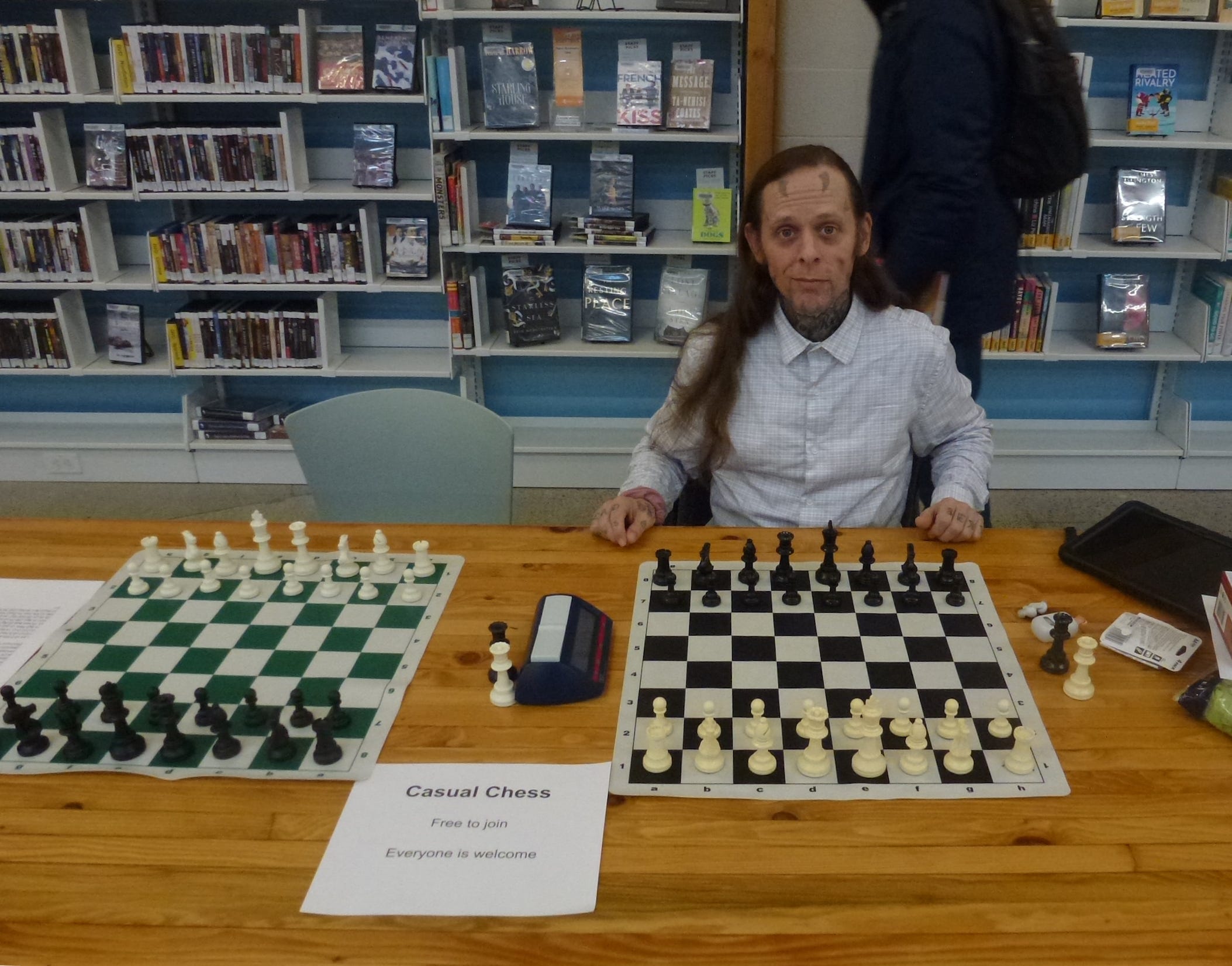
“To me, chess is life,” Kent Shawn Bedell, host of the Portland Casual Chess Club, begins.
Sitting on a large S-shaped wooden table at Multnomah County’s newly relocated Northwest Library are two chessboards, a chess clock and a sign: “Casual Chess. Free to join. Everyone is welcome.”
Behind the first board, Bedell sits, studying chess on his iPad and warmly greeting and welcoming passersby. In striking up a conversation, many an unsuspecting library patron can fall into the folly of a quick chess match.
The club holds session on Wednesdays from 3-6 p.m., and Bedell encourages all to sit down and play a game, no matter their chess ability.
“I’m here to meet people’s needs wherever they’re at,” Bedell says, explaining that he wants to create a safe and conscientious space for all of Portland’s chess players.
Bedell has been playing chess for the past 24 years, and he knows his stuff. Excitedly open to questions and what-if scenarios, he is an encyclopedia of chess-related knowledge and strategy, ready to share and teach.
For more advanced players, Bedell brings an annotated grandmaster’s game that attendees can take home and study if they wish. He tries to pick historically significant or exciting games that showcase important elements of chess strategy.
Although the club is new to the Northwest Library, it appears to be growing, with the average attendance usually sitting at around five to eight people. Bedell is also hoping to officially partner with the Multnomah County Library system, which would allow him more space and a bit of funding for hosting the event.
For Bedell, there are many reasons to play chess. From the brain health, to community, to simply the fun, a lot can be found within the 64 squares and 32 pieces of a chessboard.
“Everything that I’ve learned in chess is stuff that I can apply everywhere else in my life,” Bedell said.
Maybe it’s a glimpse into the unknown. A glimpse into a game you can never complete. The Shannon number, named after the American mathematician Claude Shannon, is the number of estimated uniquely playable chess games. After the first move, the game is split into 20 separate board states. From there, the variance ramps up quickly. After the second move, there are 400 different potential board states, then over 8,000 on the third. After a game’s first seven moves, the board could be in one of 3.19 trillion different states, far surpassing anyone’s capacity to memorize situations.
For over 1,500 years, people have been meeting in bars and cafes and on back porches and fields in pursuit of the unique intellectual challenge of chess. What better sport for a library?
Caption: One of two chessboards at Casual Chess Club at the Northwest Library on Wednesday, March 5, 2026. The chess clock is also available for those who prefer to play speed or blitz chess.
// Photo by William Morton
