


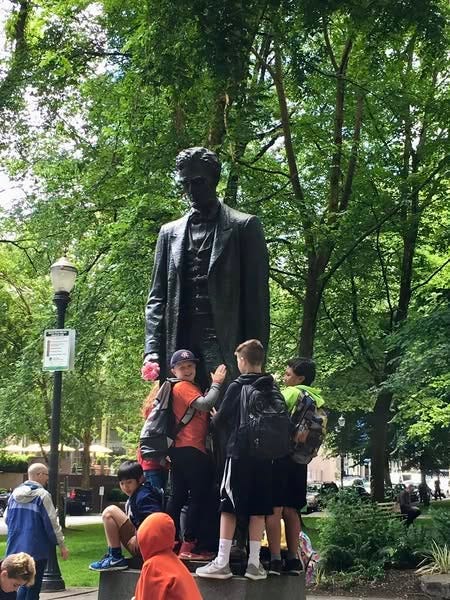
The city of Portland is hosting a public conversation on the planned return of the Abraham Lincoln monument at 6 p.m. on Tuesday, Sept. 8 at the Portland Art Museum's Mark Building, 1119 SW Park Ave.
Admission to the public forum is free, but registration is required.
According to the city website: “The conversation will feature nationally known subject matter experts in public art, conservation, history and place-keeping and include brief presentations, a panel conversation moderated by Adam Davis of Oregon Humanities, and … audience questions.
“The city plans to reinstall the restored statue in 2027 on a lower base rather than its original tall pedestal to increase accessibility and spark reflection.”
Why is it taking seven years to restore public art toppled by vandals?
The city website has a different way of describing that act: “The historic Abraham Lincoln statue was pulled down during racial justice protests in the South Park Blocks in 2020.”
In May, Darion Jones, assistant director of the Portland Office of Arts & Culture, explained the long process of restoring the statue on KOIN TV:
“We hope to add some of these additional narratives. We know that the current Lincoln monument doesn’t talk about the Dakota 38 or any of the connection in Lincoln’s history toward Oregon and tribal communities in the extent that we’d like to. And so we’re hoping that when we are ale to do this installation, we’re able to reflect a fuller version of history.
“We are hoping to also bring the sculpture closer to the public. We have a proposal right now to site Lincoln on the ground on a smaller base that will be brought closer to folks so that they can actually experience the art.”
The city promises, “Attendees will leave the event having a greater understanding of the city’s relationship to public art, monuments and history.”
The bigger question is: Will city officials leave the event with a greater understanding of that relationship?
At 5:15 p.m., before the 6 p.m. panel discussion inside the adjacent
Masonic Temple (Portland Art Museum) Building, actor and author
Steve Holgate will do his Lincoln presentation and press
conference. He'll answer questions.
I am reposting this comment that originally appeared with Fred Leeson's September 5 piece on the same topic:
Portland says its plan to put Abraham Lincoln on a much lower base reflects years of community input. But the city has not shown that Portlanders were ever asked whether they wanted the statue removed from its historic pedestal.
The public response we do have points the other way. In the city’s 2024 survey, 82 percent of about 5,000 respondents wanted Lincoln returned. The city instead relies on listening sessions, partner organizations and a symposium attended by about 100 self-selected people. The symposium discussed monuments, public memory and the city’s values in general. It did not ask participants to choose between restoring Lincoln to his pedestal and placing him near the ground.
City staff took comments gathered through these carefully framed events, selected the themes they considered important, and turned them into supposed public authority for a design the public never approved. The decision was announced in June even though PSU was still analyzing the project’s public-engagement work and the final report was not scheduled until later in the year. Now the city is holding a “public conversation” after announcing what it plans to do.
That is not community decision-making. It is a decision by city staff followed by an effort to give it the appearance of community support.
The city’s own Lewis & Clark report warned against exactly this. It said public engagement is merely performative unless people can see how their views affected the result. It called for alternatives not limited by a predetermined outcome and a clear explanation of the final decision. Where is the Lincoln-specific report showing who chose the lower base, what alternatives were considered, and why the original pedestal was rejected?
The appeal to “accessibility” is also unconvincing. Accessibility normally means providing an accessible path, viewing area and interpretive material. It does not require lowering the subject of a historic monument. The real purpose is plainly to change Lincoln’s symbolic standing—to make the monument less reverential and to cut him down to size.
Behind this is an ultra-progressive reading of history that holds Lincoln personally responsible for American expansion as an episode of settler colonialism. Because he signed the Homestead and Pacific Railway acts, he is faulted for failing to reject one of the basic policies of nineteenth-century America. This is an absurd standard. It amounts to condemning Lincoln for failing to abolish nineteenth-century America while he was preserving the Union and abolishing slavery.
Lincoln’s treatment of the Dakota deserves honest discussion. But even there, the usual account omits that Minnesota authorities wanted 303 men executed and Lincoln commuted 264 of those sentences despite enormous pressure for mass vengeance.
Lincoln and Roosevelt are historic monuments, not proposals for new public art. They are grandfathered. Portland may commission all the ground-level, interactive and non-reverential monuments it wants. It may add interpretation to the old ones. It should not redesign historic works to express the current preferences of arts administrators and then claim that “the community” made the decision.
Restore Lincoln to his pedestal. Add accurate historical context. And stop using curated community engagement to disguise decisions the public was never allowed to make.