


What: Senator Reynolds Town Hall on Harm Reduction and Syringe Services
When: Thursday, April 23 | 6–7 p.m.
Where: Virtual (Zoom)
Register: https://us02web.zoom.us/meeting/register/mWxTYUXISIKcu9KA3dclSw
Who should attend:
Anyone in the Portland metro area with a stake in how harm reduction policy is designed, sited, and governed
There is a version of the harm reduction conversation happening in Portland right now grappling with what it means to serve people in crisis without abandoning the neighborhoods around them, and that version is happening in public, with neighbors at the table, because we are the ones living with the outcomes.
There is also another version of the conversation that emerges when the room narrows, when fewer perspectives are present, and when decisions begin to take shape without the full context of how these policies are experienced on the ground.
Last month, Senator Lisa Reynolds appeared before Northwest District Association neighbors to explain why SB 1573 did not advance, a bill that would have created basic guardrails to keep syringe distribution away from school zones. The frustration expressed in that room was grounded in lived experience, and it is now part of the public record.
Much of this work around harm reduction is funded and coordinated through the county as it plays out in city spaces, which leaves fundamental questions about siting, accountability, and oversight sitting in the middle. We’re left asking who is responsible for what. We’re watching needle pickup reports across Portland increase significantly in recent years, with biohazardous waste is appearing in parks, along school routes, and in doorways.
Are these edge cases or isolated incidents? Nope — they are part of an emerging pattern that tells us why siting decisions, accountability and a continuum of care are not ideological preferences but basic public health obligations that run in both directions.
On April 23, Senator Reynolds will host a follow-up meeting to present the next iteration of harm reduction legislation, with participation expected from the health system and harm reduction side of this work. That perspective will be present and well represented, which is precisely why it is equally important for neighborhood voices to be in the room, bringing the place-based perspective that reflects how these policies are experienced day to day. Anyone in the Portland metro area who cares about how harm reduction policy is felt should consider this an opportunity to engage directly in what comes next. Curious about harm reduction outreach? Health policy folks will be in attendance.
Harm reduction done well requires more than intent; it requires accountability structures, clear operational expectations, and a genuine continuum of care¹ that connects services to outcomes in a way that works for both the people receiving them and the communities where they are delivered.
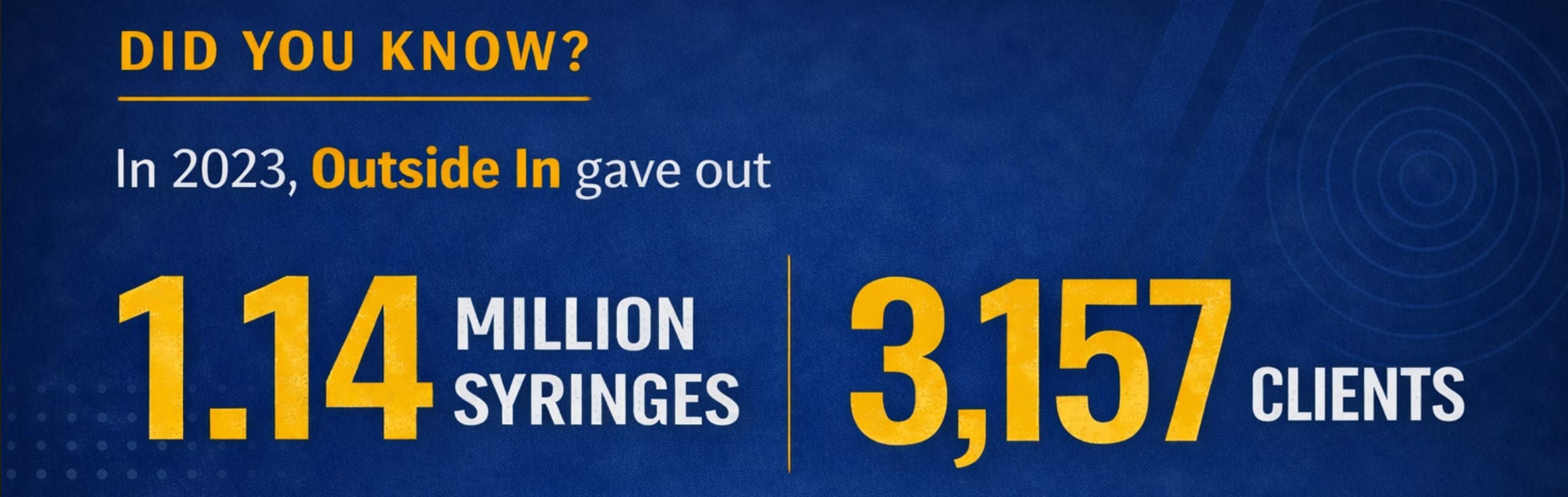
To understand the scale of what is being discussed, consider that Outside In, a Portland nonprofit providing health care and harm reduction services, operates a fixed-site syringe program steps from Lincoln High and Cathedral Schools, and distributed 1.14 million syringes to 3,157 clients in 2023 alone.
That model is institutionally accountable, with a physical location, a 990, and organizational oversight. By contrast, Portland People’s Outreach Project (PPOP), co-locating with Portland Street Medicine — a Multnomah County Measure 110 grantee — operates volunteer-run pop-ups across the city with different expectations and accountability mechanisms, often in public spaces and inside school zones. These are two distinct models operating within the same city, and the policy question now in front of Senator Reynolds is not whether harm reduction should exist, but which governance framework will shape how it operates moving forward.
The meeting next week represents a moment where that question begins to take form. Please join us in bringing the neighborhood perspective into the same room.
Register: https://us02web.zoom.us/meeting/register/mWxTYUXISIKcu9KA3dclSw
Reprinted from Stadiumhood@substack.com

The amount of time and effort spent by the Nice People in Portland on what should be a slam-dunk public policy decision borders on insane. And it's ONLY about "school zones." Gimme a break.
Handing out needles to junkies (who will do anything, including murder to feed the monkey on their backs) is like giving gasoline to pyromaniacs. It's stupid. Reckless. And it has absolutely nothing to do with caring for the cartel's customers, but is instead a narcissistic psychological sop to the providers. Two sets of junkies, perfect symbiosis.
This is such an important discussion. The County, City and the State seem to blindly espouse harm reduction and housing-first policies. They refuse to study the latest research and trends emerging in cities like LA and SFO. If they did, they'd need to acknowledge that their current policies are speeding the drug-addicted toward death, while at the same time condemning entire neighborhoods to a severe degradation in livability and safety. As Lance Orton attests, and as MANY of the folks with lived experience will agree, these policies do not serve the acutely drug addicted. Granting and encouraging the acutely drug-addicted to keep using deadly drugs simply speeds them toward death, which we are seeing ON THE STREET in the Pearl. Things are different in the age of fentanyl -- every person we see daily in the "fentanyl-fold" state is potentially very close to death. The rationale for harm-reduction no longer holds water.