


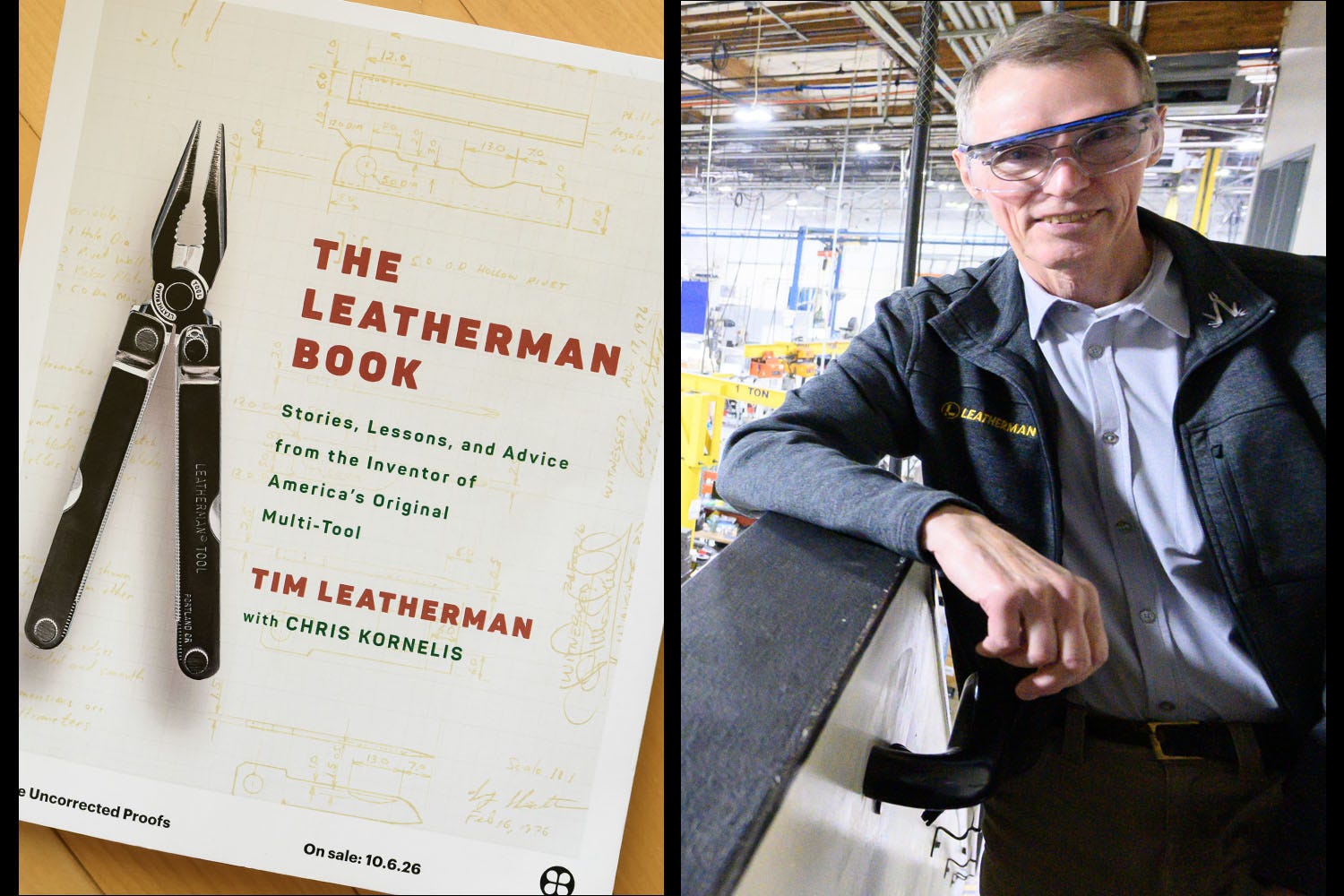
Meet the Portland man behind the Leatherman tool: Tim Leatherman. He tells his story of dreaming up, creating, designing and building his namesake company in his new book, “The Leatherman Book: Stories, lessons, and advice from the inventor of America’s original multi-tool.”
Leatherman is scheduled to speak with his co-author, Wall Street Journal reporter Chris Kornelis, at Powell’s City of Books, 1005 W. Burnside, on Tuesday, Oct. 6, at 6 p.m. This is a ticketed event.
Leatherman did not set out to change the world. In 1975, he was an Oregon State University mechanical engineering graduate fresh out of college, trying to figure out what to do with the rest of his life. He needed to find himself. It was the ‘70s so the first thing he and his new wife did was take a trip to Europe.
The invention
They traveled on the cheap. The couple stayed in run-down hotels and drove a run-down Fiat they’d bought for $300. Good thing Leatherman was mechanical, because he was constantly repairing things. If it wasn’t the carburetor in his fixers-delight of an Italian automobile, it was leaky pipes in the cut-rate hotels they crashed in.
While in Bulgaria, Leatherman had a lightbulb moment. He was once again working on some outdated hotel plumbing. He had his Boy Scout-style pocket knife with him, but he had left his pliers in the car. It was a cold, dark, rainy and altogether miserable night, and he really didn’t want to run outside to get his pliers. That’s when he jotted down his big idea: “Add pliers to pocket knife.”
Those five words were the genesis of what would become Leatherman’s worldwide business.
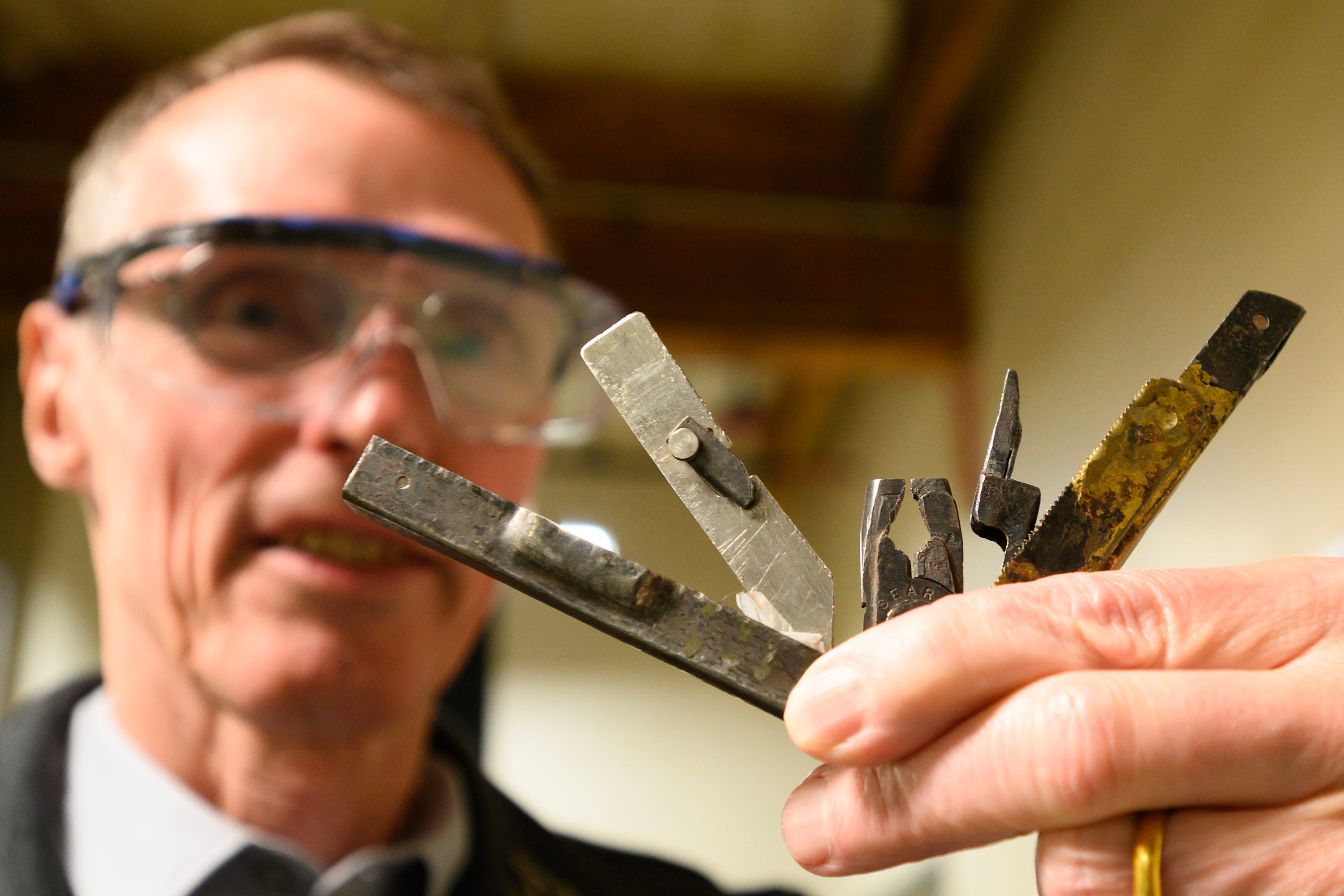
When Leatherman returned to the U.S., he started tinkering. First, in his Northwest Portland apartment, Leatherman began designing what would eventually become the world’s first multi-tool with pliers. He also used his brother-in-law’s garage in Southwest Portland to fabricate his first prototype out of scrap metal he scavenged from old washing machines. He was still doing things on the cheap.

Leatherman believed it would take him just a couple months to finish the prototype. His wife Chau agreed to hold down a job and support them financially while he worked day and night on his invention.
It would be three years of nonstop tinkering before Leatherman came up with a prototype that really worked. He filed for and received U.S. patent number 4,238,862 in December 1980 for his new compact device that included more than simply a knife and pliers. Leatherman had added a few more tools to his pocket-sized “gadget.” He included three kinds of pliers, four different types of screwdrivers, an awl, a knife and a wire-cutter. Also, a scissors, can opener and a ruler.
In 1980, the term “multi-tool” wasn’t even listed in the dictionary.
The rejections
Leatherman’s original plan was to license his product to a manufacturing company and his work would be done. He told himself, “They’ll pay me about a million dollars. I’ll sit back and live happily ever after. And that’s the end of it. But the knife company said, ‘Sorry, it’s not a knife. It’s a tool.’ The tool company said, ‘Sorry, it’s not a tool. It’s a gadget. Gadgets don’t sell.’”
Leatherman pitched his ingenious invention to every company he could think of — he even tried Nike founder Phil Knight, hoping Knight might see his multi-tool as recreation-related. Knight politely rejected Leatherman’s tool, calling it a piece of “cutlery.”
It would be another five years before the first Leatherman came off an assembly line. And that only happened after Leatherman and a partner decided to manufacture the tool themselves. It was a financial risk that eventually paid off when the newly formed Leatherman Tool Group got its first big order from sporting goods store Cabela’s.
Cabela’s couldn’t stock enough of them. They kept ordering more. That “overnight success” came a solid eight years after Leatherman first jotted that five-word note to himself that rainy night in Bulgaria. Eight years, he writes, of literal sweat and tears. And much of that work went on even after Leatherman was forced to work a regular 9-to-5 job to support his family. Most would have packed it in a lot earlier.
Leatherman Tool Group
Over the last 43 years, the Leatherman Tool Group has sold more than 90 million multi-tools. It is privately held, has never issued stock and does more than $100 million dollars a year in sales. The company now sells more than 20 different Leatherman multi-tool models.
Today, Leatherman’s home-grown manufacturing business is housed in Northeast Portland near Portland International Airport in a sprawling three-building campus of more than 200,000 square feet. That’s the equivalent of more than four football fields — a bit more space than his old walk-up on Northwest 23rd Avenue.
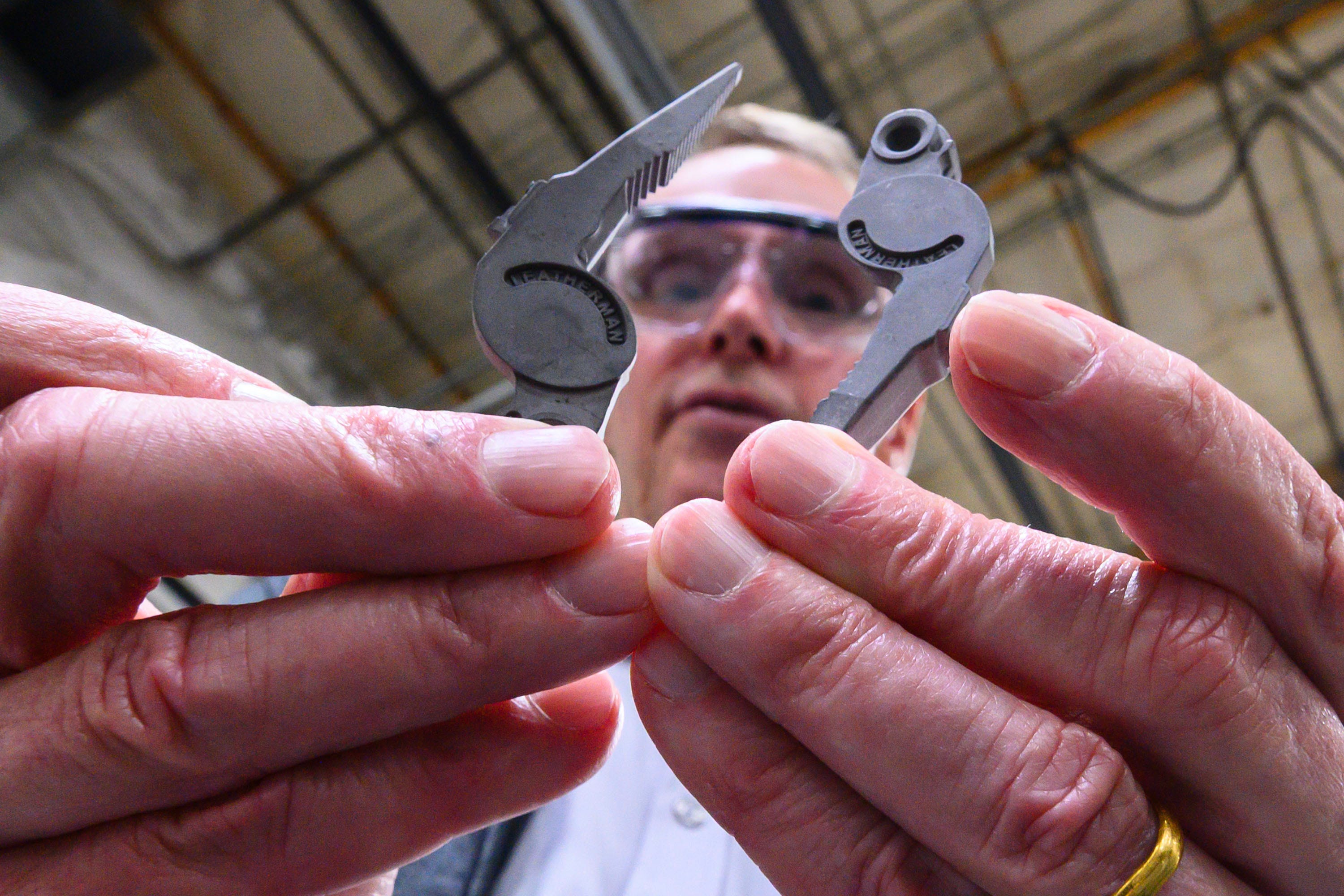
We recently met Leatherman at his company’s headquarters. Leatherman is a rare breed, a man who made an early dream come true. He may have started out to solve one simple problem, but he wound up creating an entirely new industry and selling his products in almost every corner of the globe.
This titan of industry is as mild-mannered as they come, soft-spoken and unassuming. Meeting him, it is easy to forget just how much grit, initiative and resourcefulness it took to accomplish what he has. He is proud but also modest — giving credit to his employees, his business colleagues and even those who rejected him along the way.
Leatherman graciously gave us a two-hour tour of his factory, showing us the many steps it takes to manufacture a single multi-tool.
Above: Take a 50-second tour of the Leatherman factory in Northeast Portland.
The work is labor intensive. On average, it takes 250 steps to make one Leatherman multi-tool. Each tool has between 20 and 50 parts. Leatherman manufactures a number of its products all at one time. A team of four to five people do the final assembly for each model.
Amazingly, almost every step in the production process happens in Leatherman’s sole factory, which employs more than 500 people and runs two shifts, 20 hours a day. The steel comes from Ohio and it is heat-treated on Swan Island, but everything else is done under one roof in Northeast Portland.
Above: We asked Tim Leatherman to show us around the Leatherman he carries in his pocket. It’s the deluxe Leatherman Charge model. Video runs 1:40.
Leatherman is serious about the company he built and the work that went into it, but he lights up when he recalls the huge number of personal letters Leatherman users have written him over the years. Leatherman likes to say that he invented the multi-tool, but customers taught him how to use it.
At least one letter, some years ago, had Leatherman wondering about his tool’s intended use. The envelope had printed on its outside, “This letter has been censored by the Illinois correctional authorities.” Leatherman figures it was an inmate who wanted a multi-tool to file through the prison bars. He did not fill that order. I checked: There is no record of anyone ever using a Leatherman to break out of prison.
There are less nefarious tales of escapes (and rescues) involving man and Leatherman.
Leatherman animal rescues and escapes
A Leatherman user was able to help a trapped blue heron escape a fishing net by slicing through the netting.
A reportedly grateful doe watched as a rescuer used his Leatherman to cut through fencing in order to free the doe’s trapped fawn.
And when a curious baby elephant sniffing out some oil pipes at an oil field construction site in Gabon, in west central Africa, got its trunk caught in one of the pipes’ plastic lids, a man with a Leatherman came to the young pachyderm’s aid. After the elephant was anesthetized, a Leatherman saw blade cut the plastic away, “like a hot knife through butter.”
Dramatic life-saving operations
In Iraq, a U.S. Marine used his Leatherman to perform an emergency tracheotomy on a fellow soldier after a grenade hit their Humvee.
On a fishing expedition in the Philippine jungle, a Leatherman was used to create a tourniquet for a man who had just been bitten by a venomous pit viper. That tourniquet bought rescuers enough time to get the snake-bite victim to a hospital.
Alaskan bush pilots avoided a crash by successfully fixing some wiring in flight when their landing gear failed to lower. The plane landed safely.
And there is also this heartwarming story: One man wrote to Leatherman about his father, who was stricken with ALS. As his dad lost control of his muscles and was confined to a wheelchair, he could do less and less. A Leatherman helped him open bottles and medications, tighten and loosen his feeding tubes, even helped him pick things up — allowing him to be more self-sufficient.
In its 40-plus years on the market, people have used Leatherman multi-tools everywhere on the planet, including at the north and south poles. The Leatherman has also served as a go-to tool for DIY work in outer space.
Above: Even zero-gravity can’t keep a Leatherman from performing its assigned task. While aboard the International Space Station in 2003, Oregon-born astronaut Don Pettit used his Leatherman to repair his watch. NASA video.
Popular culture
Portland-raised Simpsons’ creator Matt Groening featured a multi-tool he dubbed the “Leather Buddy” in one Simpsons episode. The animated multi-tool included some of the usual Leatherman tools, but added more gadgets than even Leatherman himself could think up, such as a toilet plunger, an umbrella, an egg beater, a cellphone, a trumpet and a weather vane. D’oh!
Above: Nothing says you’ve reached the pinnacle of popular culture like the affectionate ribbing the Leatherman received on “The Simpsons.”
Depending on the model, a Leatherman sells from $50 up to $250. The most successful model is The Wave, now replaced by the $130 Wave Plus.
However, not every multi-tool that Leatherman invented flew off the shelves. For example, the “Leatherman Flair” was invented with picnickers in mind. Leatherman customers had been asking for a corkscrew, so the company added one, plus an olive fork and a pâté spreader. The culinary multi-tool was not a smash hit. Leatherman later joked, “I guess they decided it wasn’t a good idea to change your oil one minute, then picnic the next with the same tool.” The Leatherman Flair was discontinued.
In 43 years, the Leatherman has become the tool of choice for quick fixes around the house. Campers and hikers use them. So do electricians. Police and military personnel also carry them.
When the retired chair of the U.S. Joint Chiefs of Staff, Army Gen. Mark Milley, recently visited Portland, his handlers offered him the choice of visiting one of three local famous campuses. The multinational, multi-billion-dollar companies, Intel or Nike? Or Leatherman? Milley’s decision was easy. Leatherman says he enjoyed escorting the four-star general around his factory floor.
Leatherman is still involved in the company he started, though he no longer runs day-to-day operations. In his book, Leatherman says he and CEO Kris Hamper are working with Tim’s son, Lee “to be ready for the day when he takes over as the active owner and chair of the company.” However, the 78-year-old inventor is still innovating. We asked him what he’d like to see in the next Leatherman. He said he would like to add an emergency signal to the multi-tool.
After talking with Leatherman, visiting his factory and researching this story — even bumping into my neighbor, Brad, in the elevator, who could not stop waxing poetic about his Leatherman — I’ve come to the conclusion that there are two kinds of people in this world. There are those who own a Leatherman and those of us who rely on partners or friends who own a Leatherman. I am the latter, so thank you to my husband who, with his (several) Leatherman models, fixes this, that and the other.
Also, thank you to Tim Leatherman, who made it so I never have to think about anything that is busted, broken or damaged because there is always a Leatherman within arm’s reach to fix everything.
We’re curious: How do you use your Leatherman? Any unusual experiences? Share your Leatherman story in the comments section below.
I loved reading this! Great photos and videos too. Thank you.
Wonderful story: first time I've heard or read about the history of Leatherman.